Error Coins Archives
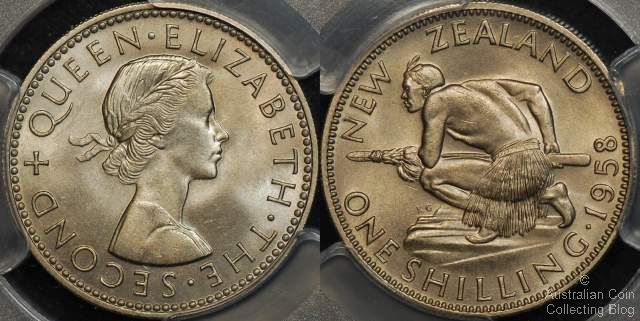
New Zealand 1958 Broken Back Shilling
Identifying the broken back variety New Zealand pre-decimal shilling can be difficult if you don't know what you're looking for. This die variety occurs in the 1942, 1958 and 1965 strikings of the shilling, here's what to look out for.
The New Zealand shilling reverse features a crouching Maori (sculpted by George Kruger Gray) in traditional dress, shirtless with a piupiu or grass skirt. At the bottom of the warrior's back to the right of his spine where it meets his clothing the broken back variety shows a lack of detail with a smooth flattened area between his back and his skirt. This is clearly shown in the comparison image below. It's very easy to see when you have a normal coin to compare that his back doesn't touch his waist. The New Zealand catalogue suggests this variety is due to die degradation or die fill but we're unable to comment on the accuracy of this. We'd need to see a number of coins of the same type from the same year to see if there is any progression of the variety during the life of the die. Best we can say right now is that the variety could be due to die degradation or fill OR could be a legitimate die variety.
This back/belt break is shown above on the 1958 shilling. There were 1,000,000 1958 shillings minted at the Royal Mint in London and released into circulation in New Zealand. Of this 1 million mintage perhaps 50,000-60,000 of the broken back variety exist suggesting one die used had the different detail in the reverse.
John Bertrand's New Zealand Coin and Banknote catalogue (2013 edition) estimates that the 1942 dated broken back shilling could have a mintage of 80,000 of the total 240,000 struck for that year. The 1965 examples are included in the total mintage of 3,500,000 and the population of the broken back variety for that year is not known.
The 1942 shillings were minted in 50% silver but the 1958 and 1965 coins are copper-nickel and can display a lovely tone. Each weighs 5.65 grams and are 23.62 millimetres in diameter with edge milling.
If these types of New Zealand varieties interest you then you should be on the lookout for the broken wing sixpence, round back vs flat back Kiwi on florins, no shoulder strap QE2 portraits and that's just the pre-decimals!
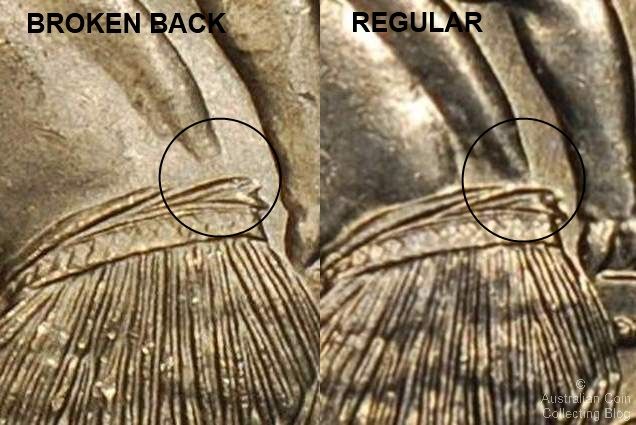
Comparison Image
Mints around the world make mistakes, it's more common than you might think. And sometimes very embarrassing. It could be a technical error, a mixup with die pairing or a very embarrassing spelling error.
Recently coming to light is an embarrassing spelling errors when the Vatican (struck by the Italian State Mint) struck and released a medal commemorating the first year of reign for Pope Francis, misspelling Jesus as Lesus. Almost all of these medals were recalled once the error was noticed but a few remain in collector hands selling for thousands of dollars. In a similar vein in 1854 some British halfpennies bore the inscription for the Queen Victoria, the V wasn't a letter V at all but an inverted A.
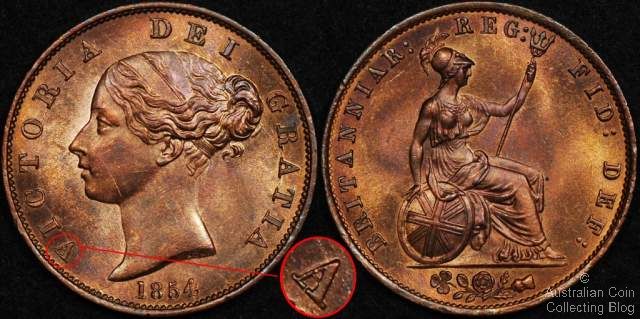
British 1854 Halfpenny with inverted A instead of V for Queen Victoria
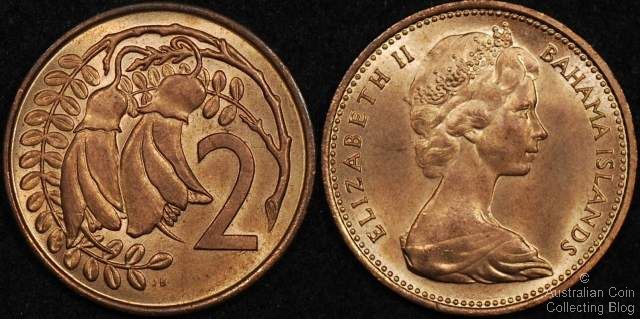
1967 (left) New Zealand new 2 Cent reverse, (right) Bahama Islands 5 cent obverse
In Australian circulating currency another type of mule springs to mind as the biggest 'whoops' made by the Royal Australian Mint. In the year 2000 the mob of roos 1 dollar coin minted for circulation was accidently struck with the wrong obverse. Only slightly smaller in diameter the 10 cent coin obverse was used on the wrong coin and it certainly stands out in the crowd.
Mistakes such as these easily stand out but other errors are not so easy to spot.
Pick up a coin from your wallet, hold it queens side facing you by the edges between your thumb and forefinger. Spin it around. Is the design still upright? If it's not then you've found an upset where one of the dies has rotated out of alignment during the production run or been incorrectly fitted in the press. The 2001 Centenary of Federation dollar is one such example that can be found in varying degrees of rotation - actually in every degree of the clock face!
Sovereigns were struck with the obverse seemingly upside down but just like US coins this is known as coin die alignment (or coin orientation) and is how they should be struck. There are just 2 known examples of the 1872 Melbourne shield sovereign being struck at a 180 degree rotation from normal (medallic alignment) which has been done in error. Eric from Drake Sterling Numismatics has written an interesting article about this error sovereign well worth reading.
If you're a keen error collector you'll always be looking out for coins that seem just not quite right....you'll know them when you see them. Don't forget that we've written about many different types of mistakes made by various mints (but in particularly the Australian mints). You should take a look at our error coin archives if you wanted to read more.

1966 Great Britain Sixpence with Straight Partial Collar Error
A partial collar coin error whether it be straight or tilted is a coin seen in many error coin collections. We've explained how this happens and is easily understood as the planchet having incorrectly seated in the dies when the coin was struck resulting in a skewed edge and partial milling. But have you thought further about why the planchet failed to sit properly in the first instance?
The answer to this question came in the form of a letter from the Royal Mint in London dated 1968 when Mr McMillan of Lanarkshire sent correspondence and an odd looking British sixpence to the Mint for examination. The coin proved to be a straight partial collar error and the documentation by JC Hill gives a suggestion as to it's occurence that we hadn't thought of before.
Prior to a coin blank being struck it is often fed through a rimming machine to be pre-rimmed before being struck into a coin. This process raises the edge of the coin and reduces the diameter of the planchet to allow for a reduced striking pressure (thus increasing the die life) and helps the coin wear better over the circulating life of the coin. Now if a coin blank missed this process of being rimmed it would therefore be more likely to not feed properly into the press resulting in an error just like a partial collar strike as it was just too large to fit correctly into the collar die.
Not all denominations of coins are pre-rimmed prior to the coins being struck. Is this why for some denominations you are much more likely to see this type of coin error? While on other denominations you just don't see with this type of error. This rimming process, or lack of it, is the likely reason for many of those partial collar errors in collector hands!

Royal Mint Letter Explanation of Error
Written by The Australian Coin Collecting Blog published in May 2013 Australasian Coin and Banknote Magazine.

Figure 1
Discovered by a bank teller in the late 1970s and put aside as something unusual, the coin shown in Figures 1 and 2 is a superb high grade brilliant red 1979 2c piece. This coin was recently purchased from an antique dealer as a partial collar error but there's more here than meets the eye.
The coin edge (Figure 3) is where the most obvious deformity lies with a step in the edge showing where the collar was engaged and where it wasn't. As is typical for a partial collar error the side of the coin that was not engaged with the collar die at the time of striking has a slightly bigger diameter than the side of the coin that was. In this case the diameter of the obverse is larger because the flan spread outwards in this area when it was struck as it was not restrained by the collar. If you look closer at the edge of this coin it's apparent that there's more than one step, which suggests this coin is something more than a partial collar error.
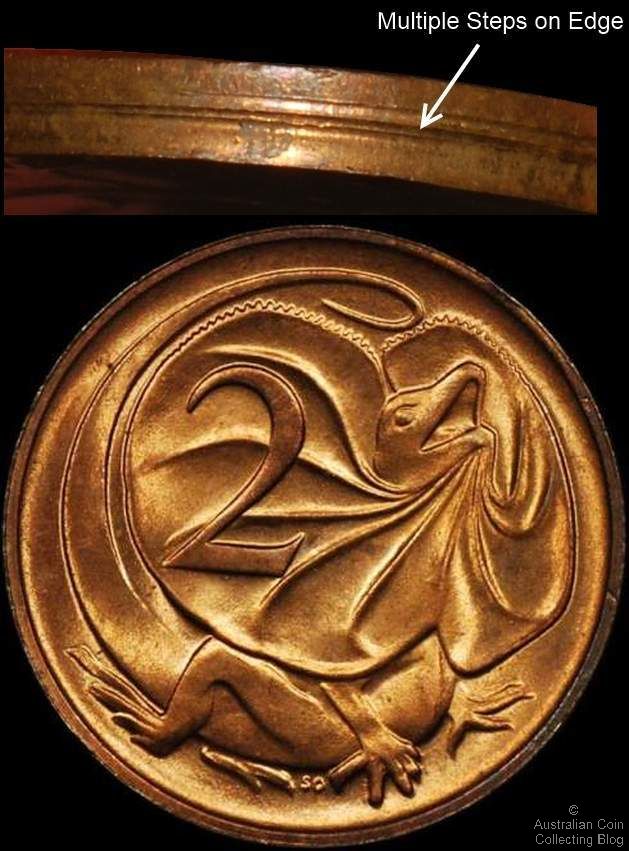
Figure 2 (bottom) and 3 (top)
Examination of the reverse of the coin (Figure 2) shows nothing of particular interest other than it being beautifully struck up. Even under a microscope there's nothing out of the ordinary to see. It's worth noting that the reverse of the coin (which was restrained by the collar) was struck by the anvil die or fixed bottom die. Close perusal of the obverse however paints a vastly different picture. Firstly, as shown in Figure 1 there are multiple rings near the rim around the obverse of the coin. Secondly, under a loupe some of the legends appear ever so slightly blurred and there's fishtailing evident on some of the letters.
It's not until we look at the obverse of the coin under a microscope that what's happened with this coin becomes more evident. Most of the obverse lettering shows evidence of radial metal flow or fishtailing. This is prominent in Figure 4 where the vertical stroke of the E has flowed outwards as indicated by the thinning of the horizontal strokes of the letter where they join the vertical stroke. Even more interestingly there's obvious proof that some of the letters have been struck more than once! Figure 5 shows the two II's of Elizabeth II have been struck multiple times. They also show radial metal flow with fishtails at the bottom of each letter. So what's going on here? The multiple steps on the coin edge suggest the coin has been struck a number of times, maybe up to 4 times. This is proven by the multiple rings around the obverse of the coin, the radial metal flow of the legends and clear visual evidence that the obverse legends have been
struck more than once.
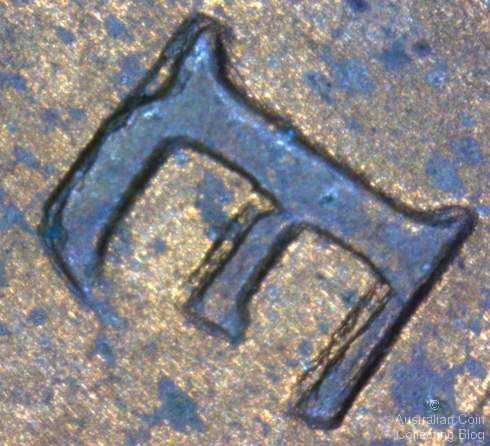
Figure 4
Here are our thoughts on how this interesting error coin came into existence. On the first strike, the coin only partially engaged with the collar and furthermore the coin must have jammed tightly in the press (collar). It was then struck again, and because it was jammed in the press so tightly there was no movement or rotation of the coin. With the obverse not being constrained by the collar the coin metal flowed outwards with each strike. The result of this is clear with obvious fishtailing, radial metal flow and multiple strikes as well as the rings near the rims.
The coin is a lovely grade, rescued by our helpful bank teller before entering circulation but the coin does have some rim damage. It's likely this occurred because the coin was jammed in the press which shut itself down in a fault condition and a minting technician used a tool to dislodge the coin and then restarted the press. Typically a multiple struck coin would appear more spectacular than this one, especially if it rotated or moved between strikes but we'll take this one as a fantastic new addition to our error collection.
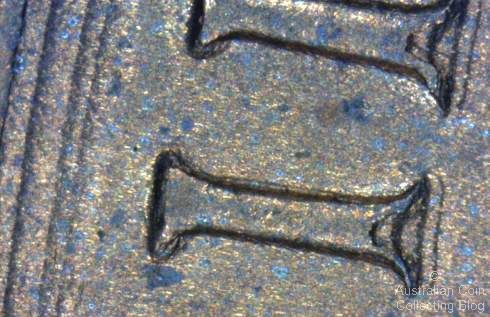
Figure 5
Acknowledgements
Thanks to Matthew Browne.
Written by The Australian Coin Collecting Blog and published in the Australasian Coin and Banknote Magazine September 2011 Volume 14 No. 8. Reproduced here for your information.
The early years of World War 2 saw the end of the Great Depression, an upswing in the Australian economy which was now on a war footing, and nearly a million cashed up US servicemen taking up residence here. These factors all combined to cause a critical lack of available coinage. Unfortunately the war effort put an unprecedented demand on our manpower and industrial capacity as well as a strain on the cash reserves of the government of the time. The Royal Mint branches in Melbourne and Perth were unable to meet the demand for either bronze or silver coins and the decision was made to manufacture coins overseas. The task fell to India to mint bronze coins in 1942 and 1943 while the USA minted silver coins (3d, 6d, 1s, and 2s) from 1942 to 1944. More than ??6 million worth of silver coins were minted in the USA during this period and Australia supplied less than half the silver required for the coins freeing up valuable funds for the war effort. The debt was not repaid until 1956 when ??3 million of silver recovered from the debasement in 1946 was supplied to the USA.
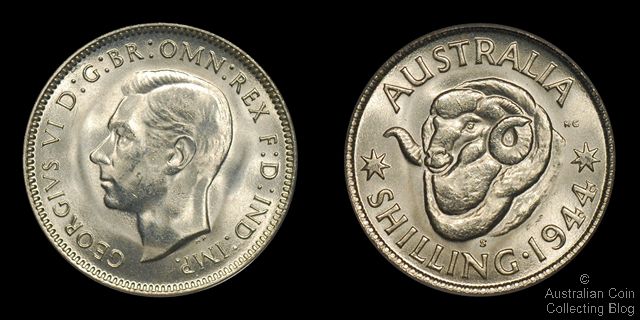
Figure 1 : a regular shilling minted in San Franciso in 1944 on a 92.5% silver planchet weighing 5.65g.
One can imagine that the US mints in Denver and San Francisco were intensely busy during this period, fully occupied with minting their own coinage as well as those of several other countries. As well as Australia these countries included Fiji, France, Greenland, the Netherlands and the Netherlands East Indies. To further complicate matters there were big changes going on with the coinage of the USA itself during the War. The USA issued a zinc coated steel cent in preference to the copper cent and also minted the so called 5c silver 'war nickel' instead of the normal 75% nickel / 25% copper coin. Both of these new compositions were designed to preserve metals that were important for war purposes. In the case of the penny, copper was required for use in ammunition while the nickel in the 5c coins was required for use in armour plating.
The frenetic activity at the mints naturally lead to a decrease in quality standards, and this is readily apparent by the number of coin errors issued by the U.S mints during WW2. Australian errors before this period are very scarce by comparison. Clipped planchets, broadstruck coins, and coins struck by filled dies are not too hard to find, but as you'd imagine florin errors are a little tougher than the other denominations. However, there is one error that is a lot scarcer than the others, the so called 'foreign planchet' strike. Contamination of barrels of blank coins of one country or denomination could easily have happened during such a busy time and sure enough this is the case. We are aware of Australian threepences struck on US dime planchets, and shillings struck on war nickel planchets.
Figure 1 shows a regular shilling minted in San Francisco in 1944 on a 92.5% silver planchet weighing 5.65g. Figure 2 shows another shilling struck in San Francisco in 1944, it is readily apparent however that this coin (in figure 2) is not a 'regular' shilling. It has clearly been struck on an undersize planchet which is evident by the missing rim around 50% of the coin's circumference. Fishtailing of the lettering (particularly strong on AUSTRALIA on the reverse) indicates that the planchet was undersize when struck rather than being damaged later. So what has happened here? There are three strong clues to a possible answer. Firstly, the coin weighs 4.95g. Secondly, as shown in the image there's a large patch of poorly mixed copper apparent on the obverse pointing to an alloy relatively rich in that metal. Thirdly, the coin has a darker appearance to a normal shilling than you'd expect.

Figure 2 : another shilling struck in San Francisco in 1944. This coin is not a 'regular' shilling. It has clearly been struck on an undersize planchet which is evident by the missing rim around 50% of the coin's circumference.
Each of these factors point to one answer about what sort of planchet this coin was struck on. It almost certainly was minted on a US silver war nickel planchet of the period (see figure 3 for a US war nickel). War nickels are composed of 56% copper, 35% silver, and 9% manganese and they weigh 5.0 grams. Thus the mass of our mis-struck shilling is consistent to that of a war nickel. Also, a war nickel planchet is rich in copper giving a quite plausible explanation for the copper impurity shown in figure 2. Finally, the manganese content in the war nickel is a neat way of explaining the darker and duller appearance of the coin. Similar observations have been made of war nickels and the 50% silver coinage of Great Britain from 1920 to 1947 which also contained some manganese. The only way to prove without doubt is to have a non-invasive metallurgical composition test conducted on the coin. Another alternative would be to it slabbed and tested by PCGS or NGC. They would label it as an error coin and record the actual composition of the coin on the holder. PCGS offer this service for around $USD310 (incl. shipping). This would boost buyer confidence and perhaps help the coin to realise a higher price if it were to be sold. Without proper metallurgical testing our theories, while quite well supported and logical, are just that, theories.
So how scarce are these war time silver coins that were struck on US or other foreign planchets? The answer is extremely scarce. The coin shown here is the only one the authors have seen at online auction for the last 5 years. Examination of public auction catalogues for all the major Australian auction houses from the last 3 years show the following (likely) wartime silver coins struck on foreign planchets (prices not inclusive of buyers premium):
March 2011 IAG Sale 73 Lot 487 1943s Shilling on War Nickel planchet realised $1,100
March 2010 IAG Sale 71 Lot 460 1943s Shilling on War Nickel planchet realised $1,320
February 2010 Roxbury Sale 77 Lot 694 1943s Shilling on USA alloy planchet for a Nickel realised $620
March 2009 IAG Sale 69 Lot 453 1944s 3d on Dime planchet realised $3,000
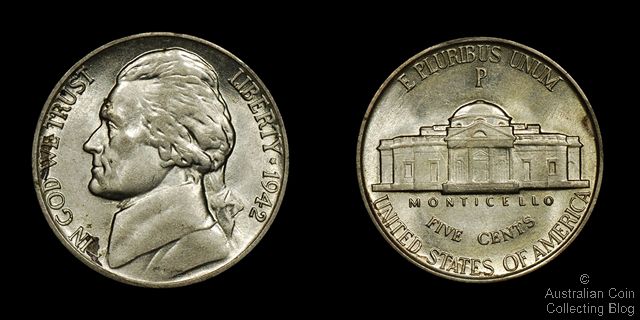
Figure 3 : the US War Nickel
There we have it, just a handful of coins; truly these foreign planchet error coins are rare indeed. We know how scarce these types of foreign planchet errors are in the decimal series. Think of the the 1981 20c struck at the Royal Mint in Wales on a Hong Kong scalloped $2 planchet. There are 6 known examples and if you could find one of those for sale we doubt you'd get much change from $15,000 (McDonald's 18th ed EF cv $7,500 seems underrated). We also know of a $2 on a euro planchet, what else is out there?
These foreign wartime planchet Australian errors are interesting finds for the afficionado and perhaps a good investment in better grades due to their scarcity. Certainly one for those from the 'thinking arm of numismatics' to keep an eye out for.
References:
Crellin, A (2009). Australian Coinage During WWII. Retrieved from http://www.sterlingcurrency.com.au/research/australian-coinage-during-wwii
Hanley, T & James, W (1965). Collecting Australian Coins. Sydney, Australia:The K.G. Murray Company Pty Ltd
Hanley, T & Myatt, W (1980). Australian Coins, Notes & Medals, Melbourne, Australia: Castle Books
Zierbath, T (2006). Foreign Coins Manufactured at US Mints. Retrieved from http://www.pdxcoinclub.org/articles/Foreign Coins Struck at US Mints CWNA article with table.pdf
Thanks to Gerry McGinley from 'At the Toss of a Coin', Adelaide for supplying the 1942P War Nickel.
NGC has brought to our attention what can only be labelled as the King of coin cuds. Their article
"Amazing Cud Error With Matching Die Steel Revealed" by Tom Delory
follows the surprising story of a US 1975-D cent with a massive cud where the die has broken away and the coin was struck with an incomplete obverse die. The most awesome part of the story is that in the bottom of the mint bag the coin was found in was the broken away piece of die! They now sit side by side in a multi coin NGC slab. Absolutely amazing.
If you're a collector of coins then chances are you know what to look out for in an error coin or know if a coin just doesn't look right or doesn't conform to the usual standard. Error coins are those that have had a mishap in the manufacturing process, either a deformation with the blank planchet or a mechanical error in the coin press.
Collecting these error coins can be very exciting and fulfilling to watch you achieve that rarer error type and add it to your collection. We've written a top ten list of the error types that are must have's in your error collection. It's fun to write a list when you first begin your collection and look back years later to see if you've fulfilled your desires. Some errors are easily found and some will take time and a lot of money to secure. Here's the list.
1. The Cud
Probably the easiest and cheapest coin error the coin cud is simply a chipped die which appears as a lump on the coin surface. Quite often they are found on the rim but can find their way onto a weak part of a coins design and can be quite small or very large. These can commonly be found in change or when searching bulk coin lots.
2. Coin Blank
Another reasonably cheap error coin is not really an error at all but an unstruck coin planchet is where every coin starts off. It's a fitting inclusion to an error collection. Make sure that your coin blank meets the exact specifications of the intended struck coin and ideally a coin blank planchet that has already been though the upsetting mill or rimming machine is more desirable as a collector piece.
3. Clipped Coin
The clipped error is a coin with a piece missing! The blanking press cutting out the planchets may have overlapped the edge of the metal coin strip, overlapped an already cut piece or an already cut coin, the resulting coin struck on an incomplete planchet can be a cool coin to have. Look out for key factors to help you determine a genuine ciip such as the Blakesley Effect and fishtailed lettering. It's very easy to be caught out buying worthless post mint damage thinking it's a genuine clip.

Cud (left) Clip (right)
4. The Partial Collar Strike
Occasionally a coin blank will fall into the coining chamber and won't be sitting in there straight. It will result in a coin struck with a partial straight or partial tilted collar, remembering the collar die is the third die that strikes the edge of the coin. If you're lucky you can find one of these in change, they are most commonly seen on dollars and the 5c. It's another must have in the ultimate error collectors collection.
5. A Ramstrike 50c
A ramstrike is a spectacular error that can take many forms but when it happens on an Australian 50c it's ultra cool and will take pride of place in your collection. The coin blank rotated slightly in the press and metal was forced upwards during the strike producing high metal lugs only seen because of the dodecagonal shape of the 50c. You'll aspire to own one of these interesting pieces.
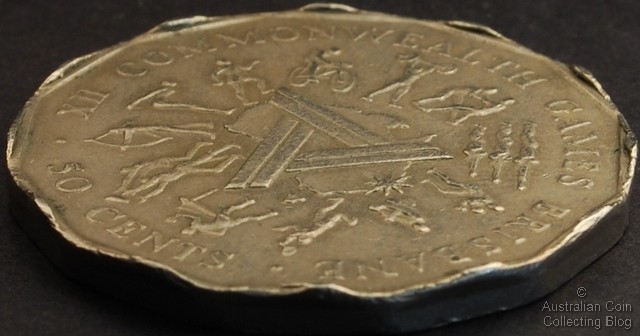
Australian 50c Ramstrike
6. The Off-Centre Strike
Off-centre or broadstrike errors again can occur at a smaller or larger % of the coin. You may have an expensive error that is more blank than coin or a budget option of say just 5% off centre.
7. The Double Strike
This error can take on a couple of different forms, either a rotated double strike within the collar or a deformed planchet extra strike on the edge of the coin, the latter being the most spectacular type. It's interesting to examine these errors closely to see the design under the second strike and also how the design can be misshaped by the overlaying strike.
8. The Split Planchet
The ultimate split planchet is two coin halves that fit neatly together and display the planchet striations in the middle. You may only have half of the split coin and be searching for it's long lost mate or maybe your coin has only a split piece revealing those striations underneath.
9. The Wrong Planchet Coin
This is very much a right place wrong time planchet error. The wrong type or sized planchet has gotten mixed up in the barrel and been struck not as it was intended. An off-metal type or a planchet from another country or even a bi-metal planchet struck with the wrong design is a special addition and a worthy inclusion in this list. Be prepared to pay big bucks for one of these errors though.
10. The Brockage
Probably the ultimate coin error and the last on the list as it may take you some time to save up for this one. They are not too hard to find generally at least a couple available in every public coin auction but can be very pricey indeed. With either a double reverse (reverse brockage) or double obverse (obverse brockage) the second side is a mirror incused image of the other side of the coin.
Note: With long hard thinking we haven't included the double obverse or double reverse coin errors as their appearance can only be described as "mint sport". There's no possible way for a coin to be struck with two heads or two tails unless the completely wrong die was put in the press and a couple of coins struck for the amusement of mint staff. Their scarcity implies that no more than just a few dozen of these coins exist in all denominations, again indicating they were struck on purpose and with intent, not the lotto winning luck of the other top ten coin errors listed.
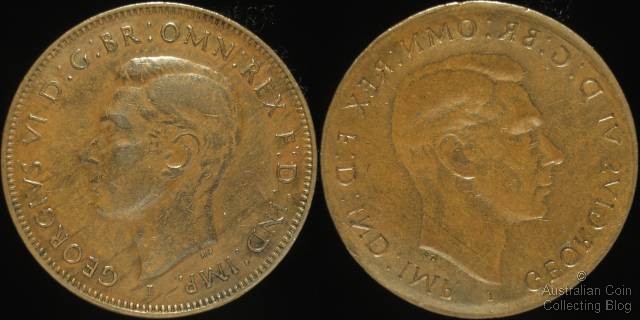
Australian Half Penny Full Obverse Brockage
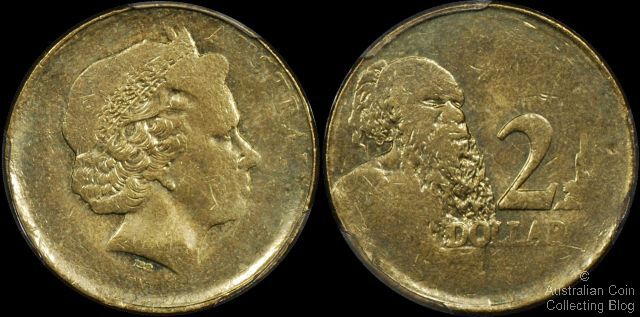
The discovery piece, the first slabbed $2 on Foreign Euro Planchet PCGS MS63
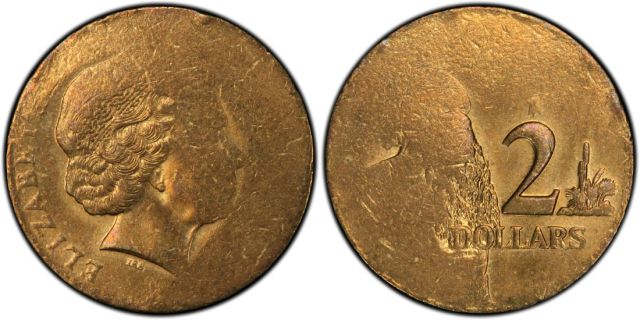
The last Downies Australian Coin Auction 312 saw 3 more Australian $2 error coins struck on foreign Euro 10 cent planchets surface. As published in Australasian Coin and Banknote Magazine in September 2012 when only one was known, the identified population of these wrong planchet errors is now 4.
Auction lot numbers 534, 535 and 536 identified a further 3 raw examples that also appear to have the same specifications. These sold for $525, $650 and $750 plus 19.25% buyers premium.
One of these examples has been graded by PCGS and is for sale on eBay starting at 99c. This newest coin is graded by PCGS as MS61. The Professional Coin Grading Service has somehow come to determine it's date as 2000 although there's no obvious date on the coin.
It will be interesting to watch this eBay auction and see what the final price* is as we were surprised at the prices achieved in the Downies auction. Having these errors identified certainly adds to their value rather than settling for the description of "coin struck on underweight planchet" or "weak strike". Maybe all of us will look closer at coins advertised this way in the future and think outside the square.
*sold on January 27th 2013 for $3050
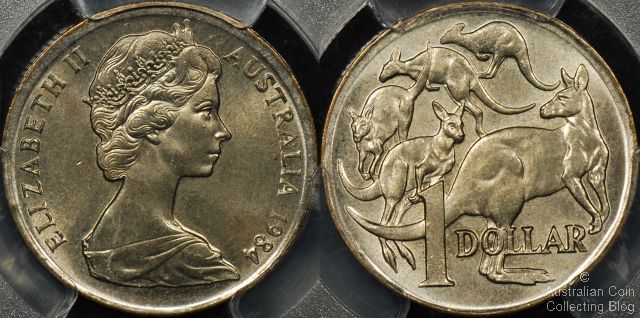
1984 Australian $1 Struck on 10c Wrong Planchet
Father Christmas must have thought I'd been very very good this year with a surprise present that is truly spectacular. Adding to my personal collection of one dollar coins and errors this 1984 one dollar is struck on an Australian 10c planchet.
1984 was the first year of issue of the one dollar coin after the $1 note was removed and a plentiful 185,985,000 were issued into circulation. This one dollar coin is struck on a cupro-nickel planchet intended for a 10c piece, underweight at 5.6g for a dollar hence the slight weakness near the rims on the coin. A regular dollar coin weighs 9 grams.
A survey of public auction results over the last 5 years indicates 7 known coins of this type and date in collector hands realising from $700 to $4,000 each. It's also a major error noted in Ian Hartshorns book "Australian Pocket Change Varieties & Errors Common, Scarce & Rare". This coin we believe is the first to be graded by PCGS as mint state MS64 or choice uncirculated. It is easily recognisable because of the cud representing a tear on the Queen's cheek which the other examples appear not to have.
It's probable that a handful or more of copper-nickel wrong planchets got mixed in with the aluminium bronze blanks striking one dollar coins and the resulting coins were fed through the system without being detected as has happened on other occasions with denominations such as 10c on 5c planchets or 20c on 10c planchets. This coin however a little more spectacular a one dollar on an off-metal planchet thus giving a silvery appearance!
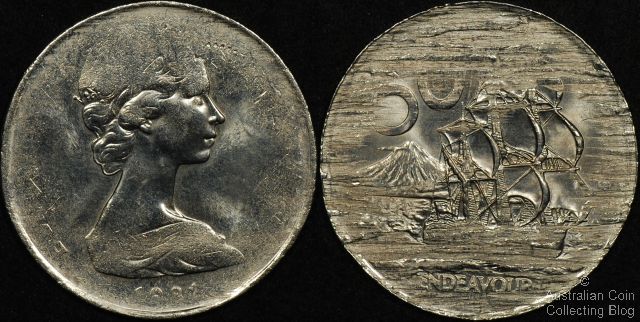
Split Planchet Coin Error
As a collector of error coins in particular errors of Australian coins there's one type of error that constantly eludes me. This article features 2 different, but very similar New Zealand 50c coins of this error type.
This coin error is called a split planchet error and there are a few types of this particular error. Split planchet means the coin blank has split, in this case in two separate pieces. The coin planchet splits (often) due to a metal impurity and this split can occur before the coin is struck or after. It can present itself as a complete split or an incomplete split known as a clamshell. You could have a struck coin which then splits into two pieces or (in the case of these 2 different New Zealand 50c pieces) the planchet split and the coin was then struck post-split on an underweight planchet.
You'll see in the images, the reverse of the top coin is struck over the split surface still showing those tell-tale metal striations. The bottom coin shows the split surface as the obverse. The design is weakly struck equally on both sides of the coin with weakness more obvious nearer the legends and rim, a tell-tale sign of a coin struck on a planchet severely underweight.
The most interesting thing about these 2 coins is that they are eerily close to being the same coin planchet, fallen in half and then struck as two individual coins. They are both of the same country, denomination, design and effigy. Sadly though once weighed, they are heavier than a complete 50c so they are from two different split planchets.
I'm very pleased to have these two coins in my collection as it's Australian cousin is very hard to come by indeed, We've only seen two examples in the past 10 years of an Australian coin struck post-split.
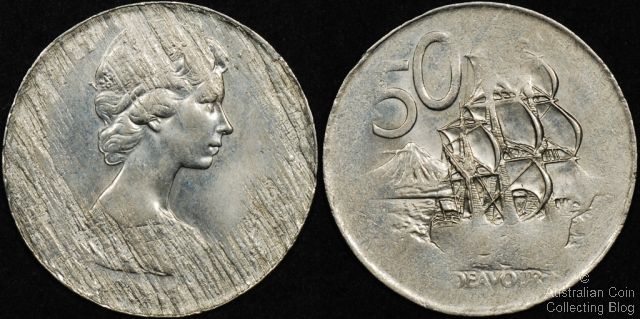
Split Planchet Coin Error