Investing in Coins Archives
Those of you who entered the Royal Australian Mint ballot for the For Valour Victoria Cross Ten Dollar coin should now know if you were successful and hold the new release in your hand. If you weren't successful then you should have received confirmation and be on the waiting list for available coins if they aren't purchased by their selected ballot winner.
How long to hold onto such a coin is the biggest question given it's popularity. I'll go so far as to say this ballot is the most successful the RAM has run in recent times with interest from coin collectors, military enthusiasts far and wide and those who want to share in the Anzac centenary experience. From a small entry sample size of 3 in my own extended family we were successful in purchasing just one coin which agrees with the Mints statistics that they received 13,000 ballot entries for a coin with a 5,000 mintage.
For an outlay of $112 I was able to purchase one of these coins, and there was never a question that I would turn down the offer if given. I eagerly opened the box hoping with fingers crossed that I had received certificate number 100 (there are 100 VC recipients, their names on the coin). It wasn't to be, the coin, a stunning antiqued bronze beauty eagerly awaiting being held, loose in the box. Without a capsule the coin is asking to be held which is the idea behind it's manufacture. It's antiqued bronze finish and large medallion-like size intended to be a tactile experience for collectors, light handling not likely to affect the finish -just like you'd hold a Victoria Cross medal itself.
Should I hold onto this new coin is the next BIG question. A ten dollar coin doesn't, at all, fit into what I collect and they have proved poor investment purchases in the past. Many $10 silver decimal issues are generally traded well below their issue price at their silver content and don't hold a numismatic value. It's the theme here that has added to the success of this coin. Currently sales on auction site eBay see this coin selling for upwards of $600 with other website dealers allowing me to add 10 of these to my shopping cart at $699.99 (presumably that's an error and they don't have that kind of stock). You'd think though that once the excitement and hype has settled down so too will the price but time will only tell. This has been a good investment so far.
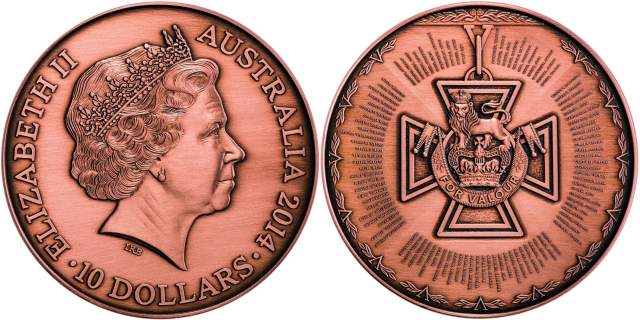
2014 Victoria Cross Ballot Coin (image courtesy www.ramint.gov.au)
It's been five years since we wrote our original 50 cent value article and 2 years since we wrote the 2012 update. We thought it was time to take a look at the latest catalogue values of our Aussie 50c coins and see how the values have changed since we first looked at them.
We've taken the values of these coins from the 2014 edition of the Pocket Guide to Australian Coins and Banknotes written by Greg McDonald. The values are for pristine uncirculated examples of the coins. They are also what you can expect to pay for the coins from a coin dealer rather than what you can expect to sell them for. Expect half catalogue value (at most) if you're trying to sell these coins to a coin dealer (they have to make a profit) and don't be surprised if you just get offered face value (or fifty cents). If you've got some collectable 50 cent coins you want to sell then you might actually be better off doing it yourself via an online auction site like eBay.
- 1970 Captain Cook Bicentenary, mintage: 16,548,100, $7.00
- 1977 Silver Jubilee, mintage: 25,067,000, $4.00
- 1981 Royal Wedding, mintage: 20,000,000, $6.00
- 1982 Commonwealth Games, mintage: 23,287,000, $4.00
- 1988 First Fleet Bicentenary, mintage: 8,990,800, $10.00
- 1991 Decimal Anniversary, mintage: 4,704,400, $10.00
- 1994 Year of the Family (narrow date), mintage: 20,830,800, $18.00
- 1994 Year of the Family (wide date), mintage: 20,830,800, $12.00
- 1995 Weary Dunlop, mintage: 15,869,200, $7.00
- 1998 Bass and Flinders, mintage: 22,426,000, $7.00
- 2000 Year 2000 Millennium, mintage: 16,630,000, $7.00
When we compare those values to the original article we wrote in 2009 and the last one we wrote in 2012 there's only two values (yes, two) that have changed. The 1988 First Fleet 50c has dropped in value by $5. And the 1994 Narrow Date Year of the Family 50 cent has increased in value by $6. So we've got a total increase in value in 5 years of $1 for that entire list of 50 cent coins. A thrilling return on investment that is not!
In the last update of this article we expanded it to include some more recent coins than the original article covered. Here's those coins again along with their current CV's. Note, again, that these values are for uncirculated coins only rather than the ones you might find in your change. I've also adjusted some of the mintages of the Centenary of Federation coins based on our own research into mintage figures. You should take a look at our Federation coins page for more information on each coin.
- 2001 Centenary of Federation, mintage: 43,149,600, $4.00
- 2001 Centenary of Federation NSW, mintage: 3,042,000, $6.00
- 2001 Centenary of Federation ACT, mintage: 2,000,000, $6.00
- 2001 Centenary of Federation QLD, mintage: 2,320,000, $6.00
- 2001 Centenary of Federation VIC, mintage: 2,000,000, $6.00
- 2001 Centenary of Federation Norfolk Island, mintage: 2,000,000, $6.00
- 2001 Centenary of Federation NT, mintage: 2,000,000, $6.00
- 2001 Centenary of Federation WA, mintage: 2,000,000, $6.00
- 2001 Centenary of Federation SA, mintage: 2,400,000, $6.00
- 2001 Centenary of Federation TAS, mintage: 2,106,006, $6.00
- 2002 Year of the Outback, mintage: 11,507,000, $6.00
- 2003 Australia's Volunteers, mintage: 13,927,000, $4.00
- 2004 Student Design, mintage: 10,200,000, $3.00
- 2005 60th Anniversary of WW2, mintage: 20,719,000, $3.00
There's a been a bit of movement in the coins in this list since we looked at them in 2012. The 2001 Centenary of Federation (Australia) coin has dropped in value by $1, and the ACT, Norfolk Island, and South Australian Federation coins have all increased in value by $2. Slightly better returns there and given that the Centenary of Federation 50 cent coins can be found in change still you could do worse than noodle through bags of coins from your bank to try to put together full sets. They'll certainly be worth more than face value.
At the suggestion of one reader we've decided to include a couple of standard design coat of arms 50 cent coins in this article. These are the 1985 and 1993 coins, both released into circulation with a mintage of a million or a bit less, which is a low mintage for any circulation decimal coin.
- 1985 Coat of Arms 50 cent, mintage: 1,000,000, $13.00
- 1993 Coat of Arms 50 cent, mintage: 982,800, $22.00
In 2009 the 1985 50 cent was valued at $13 and 2012 the same. Similarly the 1993 coat of arms 50 cent has been valued at $22.00 since 2009. So not a lot of investment return there either. However, given that the values are quite high there might be some potential for resale if you happen to find one of these coins in better condition (say EF or better) from circulation.
There's one last 50 cent coin that we look at each time we write these articles. The 1966 round 50 cent, which is 80% silver and contains about 1/3 of an ounce of the precious metal. In our last update in 2012 silver was at AU$27.50 an ounce and each round 50 was worth approximately $9.20 in silver. Right now silver is at AU$22.20 an ounce and each 50 cent round is worth AU$7.40. So, if you bought up big on round 50c back in mid 2012 you're down about 20% on your investment. But if it cheers you up any back in 2011 when silver prices peaked at about AU$45 per ounce each round 50 was worth $15 and you would have lost more than 50% of your investment if you still held them today. Ouch.
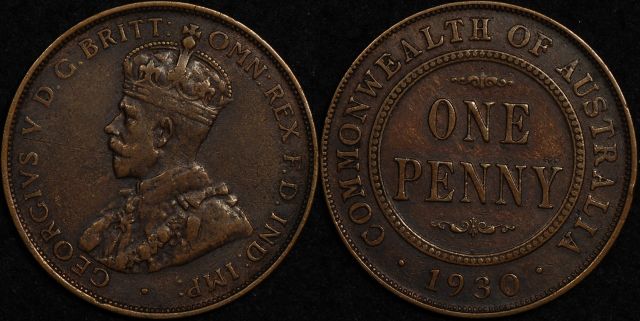
1930 Penny Real or Fake?
Even if you're not a coin collector the Australian 1930 penny is the one you'll know about. It's the most famous Australian pre-decimal coin and as such is the most talked about, the most sought and the most faked coin. Find a 1930 penny and your heart will skip a beat, but the likelihood that it's real is very small. Given the value of a real 1930 penny is upwards of $15,000 in any condition it's one that you're going to want to authenticate if you find a 1930 penny in Grandpas top drawer.
If you've found a 1930 penny and are wondering it's value, first you'll have to determine if it is real. Your newly found 1930 penny may be one of 2 things (well, 3 if it's real!), it will commonly be a forgery or an altered date penny.
Forgeries, counterfeits, fake and copy coins are in their plenty in Australian penny collections as they are easily obtained. Even the British penny is used in its place in many collections so there isn't a glaring vacant space. A copied coin should be marked 'copy' but is usually not. Fake 1930 pennies usually stand out amongst the rest as they are often poor quality forgeries with details that just look plain wrong to the eye when studied next to a real Aussie penny. Fake 1930 pennies often have bright lustre that is a tell-tale sign that it's a recent copy.
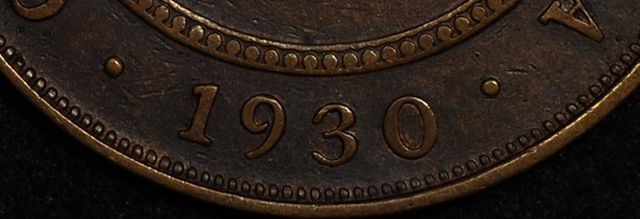
A Real Penny, Sadly Not a Real 1930 Penny
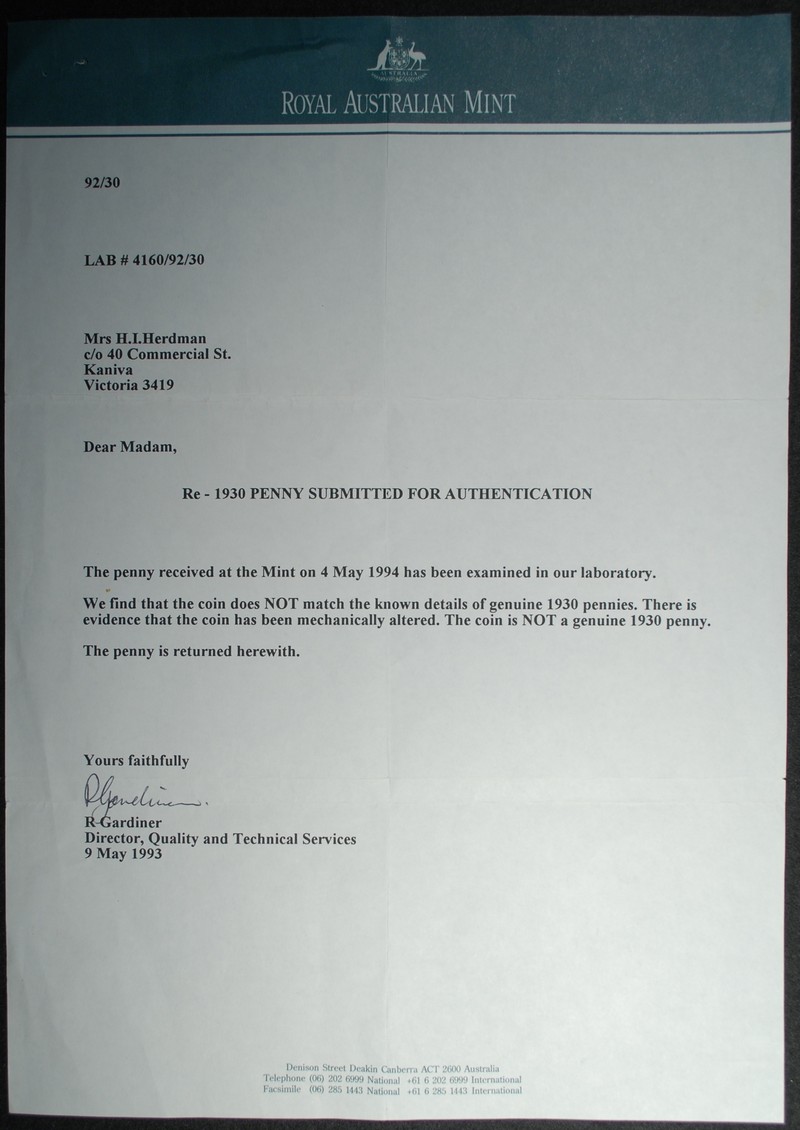
In the past, those with the intent to deceive have taken an Australian penny from another year and changed the date to make it appear as a 1930 coin. Whilst this isn't an offense, it becomes so when this coin is attempted to be passed off as a real 1930 penny. This type of coin is called an 'altered date' penny. Now this altered date type is the only 1930 penny I'll ever be able to afford and it comes with a letter from the Royal Australian Mint advising as such. A collector in the past sought advice from the experts, which the Mint used to do for a fee, and appraised the coin to determine if it were genuine. The letter of advice is seen below.
Collectors and investors at the top end of the rare coin and banknote market have been dealt another blow with the second major Australian numismatics dealer in the last year heading to the liquidators.
The Rare Coin Co. based in Western Australia have gone into receivership under the wing of Perth based Sheridans Chartered Accountants. The accounting firm will wind up the business and attempt to recoup money invested by many people who were investing for future returns for income or for their superannuation. Mum and Dad investors, business tycoons and Aussie farmers are among those seeking to sell rare coins and banknotes that were purchased in what appeared to be an artificially inflated marketplace. Now that certain sectors of the Australian coin and banknote market have seen drawbacks these investors are now seeing losses of many thousands or even tens of thousands of dollars. Changes to the rules governing self managed superannuation funds means that coins and banknotes (and other collectables) are now controlled more tightly and many investors have sought to sell off these types of assets. This is likely to be a contributing factor to the latest downfall in prices of banknotes in general and some collectable Australian coins.
Only 9 months ago in October 2012 administrators were appointed to John Pettit Rare Banknotes operating in Sydney. Strangely enough the John Pettit website still seems to be active. The rare banknote dealer reported losses of $2.4 million over 5 years but the exact magnitude of the loss and the point at which the business became insolvent were difficult to determine due to poor record keeping. It's interesting to note both companies now in crisis offered a buy-back guarantee on coin and banknotes sold to investors which it appears they could ultimately not fulfil.
Perhaps this is a warning to anyone looking to invest in coins and banknotes that they do their due diligence before investing under such guarantees. We do not offer investment advice on this blog and suggest if you are going to collect coins or banknotes then do so for the love of it. We have heard too many sad stories about investors who have lost money investing in coin and banknotes who knew little or nothing about the coins or banknotes they were purchasing. As always buyer (and investor) beware.
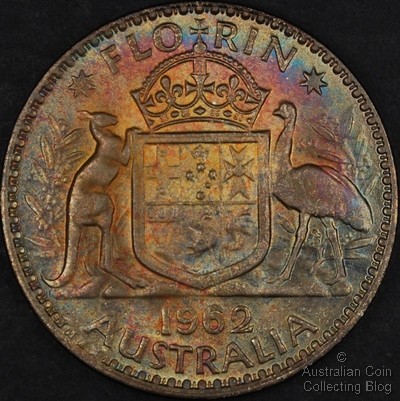
It's been nearly 50 years since the florin (or 2 shilling) coin circulated in Australia. If you've come into ownership of a florin, perhaps in an inheritance, a lucky find digging in the garden or discovered in the the drawers of an old cupboard then you might be asking yourself what's an Australian florin worth? Well, there's two things to take into account.
The first, is the year of the coin. Prior to 1946 each 11.31 gram Australian two shilling piece contained 92.5% silver which is just over 1/3 of an ounce of silver. At the time of writing pre 1946 florins (or "pre florins") have a melt value of AU$9.54 regardless of their condition. Florins minted from 1946 to 1963 contained only 50% silver which amounts to 0.1818 of an ounce of silver. These "post florins" have a silver bullion value of AU$5.15 at time of writing. Remember that you can use our Australian Silver Coin Calculator to calculate the melt value of Australia florins.
However, before you rush off and accept melt value (or pass it off as a 20c coin) for your Australian florins you should check the year of the coins carefully because some years are worth a lot more than their bullion value regardless of condition. Pretty much any florin prior to 1920 can be worth a few multiples of silver value even in very poor grades. But more importantly the key date 1932 florin and 1939 florin can be worth $100+ in well circulated grades up to several thousand in pristine uncirculated grades.
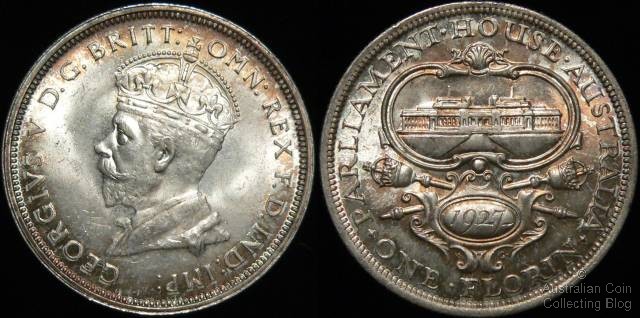
The second thing to consider when determining what your Australian florin is worth is the grade of the coin. Now, coin grading is a complex topic and we won't go into details here but be aware that an uncirculated coin can be worth many multiples of what a circulated coin of the same year is worth. An uncirculated coin is one that has not been in circulation and has no wear or metal removed from it. It doesn't necessarily mean that the coin is shiny and bright so don't be tempted to polish up your florins to make them look better as this can ruin any numismatic value they might have. An example of grade affecting value is the Australian 1956 florin. A lovely, choice uncirculated florin of this relatively late year could be worth $400 or more. A well worn coin of the same year is really only worth the silver it contains or a fraction more than $5.
In conclusion you should be careful to do some research before deciding on the value of your Australian florins. Our Australian Silver Value Calculator is a decent starting point. But you should also think about visiting a library to borrow a coin catalogue or look at past results on eBay for coins of the same year and condition as your florins.
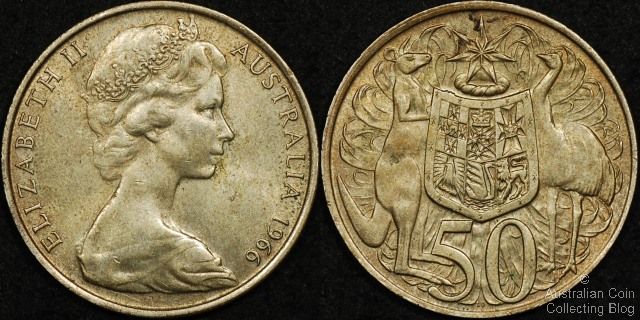
Australia 1966 50c
The legendary round 50 cent piece holds a special place in the hearts of many Australians. Those of us who are old enough to remember the decimal changeover remember the round 50 cent coin as an oddity that was hoarded by thousands of Australians. This was because in 1966 when the coin was issued the nearly 1/3 of an ounce of silver it contained was almost immediately worth more than the face value of the coin itself. Because of it's place in Australian folklore most people believe that the round 50c piece is a truly valuable coin. Sadly, because so many of these coins were minted (more than 36 million) they coin is neither scarce or particularly valuable In fact the 1966 50 cent coin value is generally only the value of the silver it contains.
Because of this, the round 50c bearing the Arnold Machin portrait of Queen Elizabeth II and the Stuart Devlin Coat of Arms reverse is only really traded as silver bullion. Some coins in exceptional grades may sell as numismatic coins but even these are only worth 2-3x the silver the coins contain. Bags of 100's of the coins regularly change hands purely for the intrinsic value of the silver they contain. Sometimes, no doubt, the coins reach the melting pot and are rendered down for the 80% silver each 13.28g coin contains.
With some internet trickery we can tell you that the silver value of a round 50 cent coin is currently AU$14.53 (US$9.62). This value is updated every hour or so using the current silver price and exchange rates from Kitco. If you want to know the value of a hoard of round 50c coins then please take a look at the Australian Silver Bullion Coin Calculator. This will tell you the bullion value of any number of 1966 50c coins plus the silver value of many other Australian Silver Coins.
If you want to buy a circulated round 50c piece for your collection then don't pay more than 10-20% above the bullion value of AU$14.53 (US$9.62) per coin. If you want a nice uncirculated coin or even a choice uncirculated coin then at time of writing (February 2013) we wouldn't recommend spending above $20 per coin.
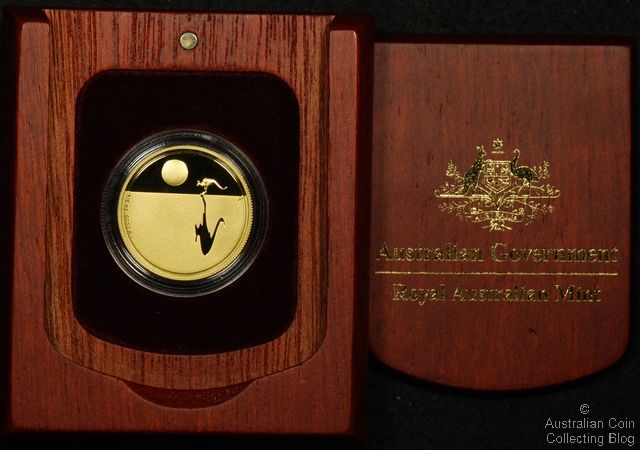
2013 Kangaroo at Sunset Gold Proof
The 2013 Kangaroo at Sunset ballot has been and gone and we don't know of any participant missing out on winning a coin in this ballot although it was fully subscribed.
The Wojciech Pietranik design is one of the flagship pieces by the Royal Australian Mint. It depicts a lone kangaroo crossing the red soil desert plains against a setting sun capturing the beauty of the Aussie outback. This gold proof coin has proved very popular over the years so much so that the Royal Australian Mint now conducts a ballot for it's distribution. Collectors on the RAM mailing list are sent a ballot form to fill out and return to go into the draw for the opportunity to buy one of these coins. Ballots needed to be returned to the Mint by November 27th with the draw taking place on November 30th 2012.
With a mintage of 1,000 coins, 998 were available for collectors and 2 placed in the National Coin Collection. The Kangaroo at Sunset design has been minted since 2007 in 99.9% fine gold and can also be found in 1oz silver. Each $25 legal tender gold coin weighs 6.22g or one fifth of an ounce. It's a mere 21.69mm in diameter with edge reeding and is struck with the Ian Rank-Broadley effigy of Queen Elizabeth II. The proof coin protected in a capsule is housed in a quality Jarrah presentation box. It's released with a certificate of authenticity for issue price of $650.
We've written entries for the previous Roo at Sunset gold coins 2009, 2010, 2011 and 2012.
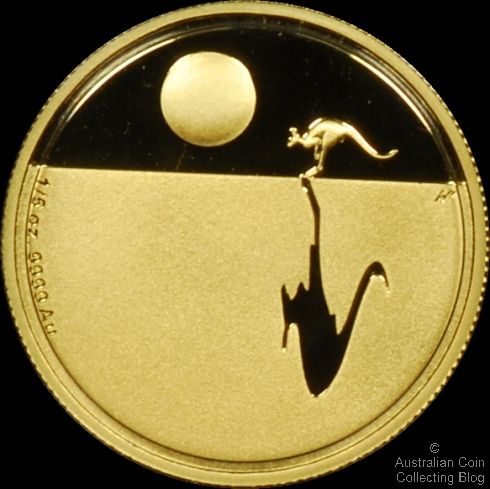
2013 Kangaroo at Sunset Gold Proof
When it's in different packaging of course! The Perth Mint coin collector blog has been discussing this very issue recently with clarification from them that it is highly likely they'll mint more of an issue and release it in different packaging making low mintage coins not as sought after or not as rare as collectors were led to believe.
They'll reword their Certificates of Authenticity to read:
The Perth Mint will release no more than x,xxx of these coins in this packaging.
This lends them approval to mint more of the same coin at a later date and release it in different packaging or in a set with other coins as per the limits approved in the Currency Determinations which are not made public. These maximum approved mintages don't expire so a further striking of a 2012 coin could legally happen in 5 or 10 years time!
Collectors are already fuming with a backlash expected to hit the hip pocket of the Perth Mint.
The full discussion:
Total vs. Certificate mintages
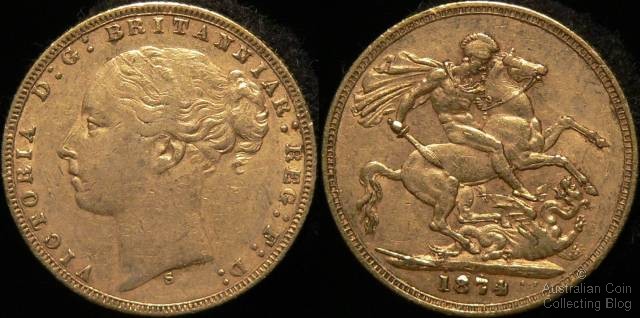
Australian Gold Sovereign
The sovereign is a highly collected gold bullion coin as well as many rare dates and high grades being keenly sought by the elite coin collector. The gold sovereign was and is minted for many countries including Great Britain, Australia, Canada and South Africa. It is also collected to hoard the commodity gold betting on a rise of the precious metal base price or the exchange rate making your gold stash more valuable. You might also be surprised by the amount of gold in a sovereign and that it does have considerable value as a bullion coin in any condition.
A gold sovereign contains .2354 troy oz of gold equivalent to 113.0016 grains and should weigh 7.322381g. Each is struck in 22 carat gold which is a fineness of .916.
Work out the value of your gold sovereign, half sovereign or other gold coins on the World Gold Coin Value calculator.
With the power of a little bit of internet magic we've worked out today's* bullion value of a gold sovereign at .
*yes, that's today's value and not the day this article was written. This value is updated every hour or so using the current gold price and exchange rates from Kitco.
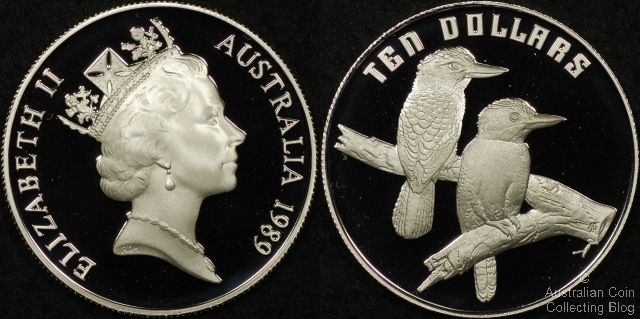
1989 10 Dollar Kookaburra Silver Proof
The ten dollar Birds of Australia series silver coins were issued by the Royal Australian Mint from 1989 to 1994. They depict the Kookaburra, White Cockatoo, Jabiru, Penguin, Cockatoo and Wedge Tailed Eagle.
They were issued as standard proofs, piedfort proofs and a limited piedfort coin fair issue. The piedforts are twice as thick weighing twice as much as the standard proofs.
Whilst collectible in their own right they are often traded for their silver bullion content and it's this silver content that often determines the "going rate" of the coins being sold rather than the catalogue value. Thus a knowledge of the bullion trading price is important if you're going to trade in these coins.
They were minted in 92.5% silver and 7.5% copper (sterling silver). They all have edge reeding, are 34.1mm in diameter and weigh 20 grams each. Remember the Piedforts are twice this at 40 grams but the same diameter.
You can work out todays value of these and other silver coins using our Australian Silver Value calculator.
Or through a little bit of internet coding magic today's value of a Birds of Australia standard $10 silver coin is . This value is updated every hour or so using the current silver price and exchange rates from Kitco.