Collecting Coins Archives
It's been five years since we wrote our original 50 cent value article and 2 years since we wrote the 2012 update. We thought it was time to take a look at the latest catalogue values of our Aussie 50c coins and see how the values have changed since we first looked at them.
We've taken the values of these coins from the 2014 edition of the Pocket Guide to Australian Coins and Banknotes written by Greg McDonald. The values are for pristine uncirculated examples of the coins. They are also what you can expect to pay for the coins from a coin dealer rather than what you can expect to sell them for. Expect half catalogue value (at most) if you're trying to sell these coins to a coin dealer (they have to make a profit) and don't be surprised if you just get offered face value (or fifty cents). If you've got some collectable 50 cent coins you want to sell then you might actually be better off doing it yourself via an online auction site like eBay.
- 1970 Captain Cook Bicentenary, mintage: 16,548,100, $7.00
- 1977 Silver Jubilee, mintage: 25,067,000, $4.00
- 1981 Royal Wedding, mintage: 20,000,000, $6.00
- 1982 Commonwealth Games, mintage: 23,287,000, $4.00
- 1988 First Fleet Bicentenary, mintage: 8,990,800, $10.00
- 1991 Decimal Anniversary, mintage: 4,704,400, $10.00
- 1994 Year of the Family (narrow date), mintage: 20,830,800, $18.00
- 1994 Year of the Family (wide date), mintage: 20,830,800, $12.00
- 1995 Weary Dunlop, mintage: 15,869,200, $7.00
- 1998 Bass and Flinders, mintage: 22,426,000, $7.00
- 2000 Year 2000 Millennium, mintage: 16,630,000, $7.00
When we compare those values to the original article we wrote in 2009 and the last one we wrote in 2012 there's only two values (yes, two) that have changed. The 1988 First Fleet 50c has dropped in value by $5. And the 1994 Narrow Date Year of the Family 50 cent has increased in value by $6. So we've got a total increase in value in 5 years of $1 for that entire list of 50 cent coins. A thrilling return on investment that is not!
In the last update of this article we expanded it to include some more recent coins than the original article covered. Here's those coins again along with their current CV's. Note, again, that these values are for uncirculated coins only rather than the ones you might find in your change. I've also adjusted some of the mintages of the Centenary of Federation coins based on our own research into mintage figures. You should take a look at our Federation coins page for more information on each coin.
- 2001 Centenary of Federation, mintage: 43,149,600, $4.00
- 2001 Centenary of Federation NSW, mintage: 3,042,000, $6.00
- 2001 Centenary of Federation ACT, mintage: 2,000,000, $6.00
- 2001 Centenary of Federation QLD, mintage: 2,320,000, $6.00
- 2001 Centenary of Federation VIC, mintage: 2,000,000, $6.00
- 2001 Centenary of Federation Norfolk Island, mintage: 2,000,000, $6.00
- 2001 Centenary of Federation NT, mintage: 2,000,000, $6.00
- 2001 Centenary of Federation WA, mintage: 2,000,000, $6.00
- 2001 Centenary of Federation SA, mintage: 2,400,000, $6.00
- 2001 Centenary of Federation TAS, mintage: 2,106,006, $6.00
- 2002 Year of the Outback, mintage: 11,507,000, $6.00
- 2003 Australia's Volunteers, mintage: 13,927,000, $4.00
- 2004 Student Design, mintage: 10,200,000, $3.00
- 2005 60th Anniversary of WW2, mintage: 20,719,000, $3.00
There's a been a bit of movement in the coins in this list since we looked at them in 2012. The 2001 Centenary of Federation (Australia) coin has dropped in value by $1, and the ACT, Norfolk Island, and South Australian Federation coins have all increased in value by $2. Slightly better returns there and given that the Centenary of Federation 50 cent coins can be found in change still you could do worse than noodle through bags of coins from your bank to try to put together full sets. They'll certainly be worth more than face value.
At the suggestion of one reader we've decided to include a couple of standard design coat of arms 50 cent coins in this article. These are the 1985 and 1993 coins, both released into circulation with a mintage of a million or a bit less, which is a low mintage for any circulation decimal coin.
- 1985 Coat of Arms 50 cent, mintage: 1,000,000, $13.00
- 1993 Coat of Arms 50 cent, mintage: 982,800, $22.00
In 2009 the 1985 50 cent was valued at $13 and 2012 the same. Similarly the 1993 coat of arms 50 cent has been valued at $22.00 since 2009. So not a lot of investment return there either. However, given that the values are quite high there might be some potential for resale if you happen to find one of these coins in better condition (say EF or better) from circulation.
There's one last 50 cent coin that we look at each time we write these articles. The 1966 round 50 cent, which is 80% silver and contains about 1/3 of an ounce of the precious metal. In our last update in 2012 silver was at AU$27.50 an ounce and each round 50 was worth approximately $9.20 in silver. Right now silver is at AU$22.20 an ounce and each 50 cent round is worth AU$7.40. So, if you bought up big on round 50c back in mid 2012 you're down about 20% on your investment. But if it cheers you up any back in 2011 when silver prices peaked at about AU$45 per ounce each round 50 was worth $15 and you would have lost more than 50% of your investment if you still held them today. Ouch.
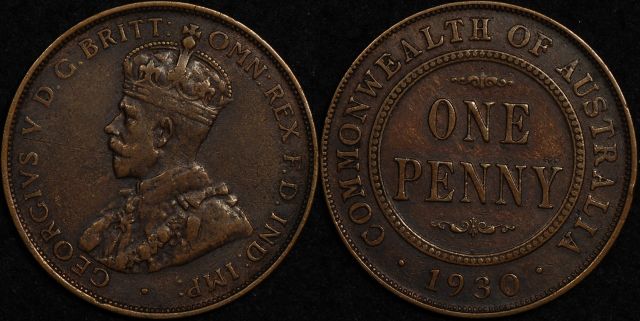
1930 Penny Real or Fake?
Even if you're not a coin collector the Australian 1930 penny is the one you'll know about. It's the most famous Australian pre-decimal coin and as such is the most talked about, the most sought and the most faked coin. Find a 1930 penny and your heart will skip a beat, but the likelihood that it's real is very small. Given the value of a real 1930 penny is upwards of $15,000 in any condition it's one that you're going to want to authenticate if you find a 1930 penny in Grandpas top drawer.
If you've found a 1930 penny and are wondering it's value, first you'll have to determine if it is real. Your newly found 1930 penny may be one of 2 things (well, 3 if it's real!), it will commonly be a forgery or an altered date penny.
Forgeries, counterfeits, fake and copy coins are in their plenty in Australian penny collections as they are easily obtained. Even the British penny is used in its place in many collections so there isn't a glaring vacant space. A copied coin should be marked 'copy' but is usually not. Fake 1930 pennies usually stand out amongst the rest as they are often poor quality forgeries with details that just look plain wrong to the eye when studied next to a real Aussie penny. Fake 1930 pennies often have bright lustre that is a tell-tale sign that it's a recent copy.
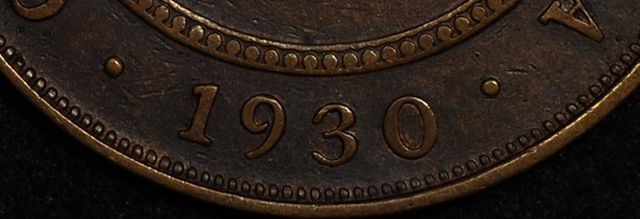
A Real Penny, Sadly Not a Real 1930 Penny
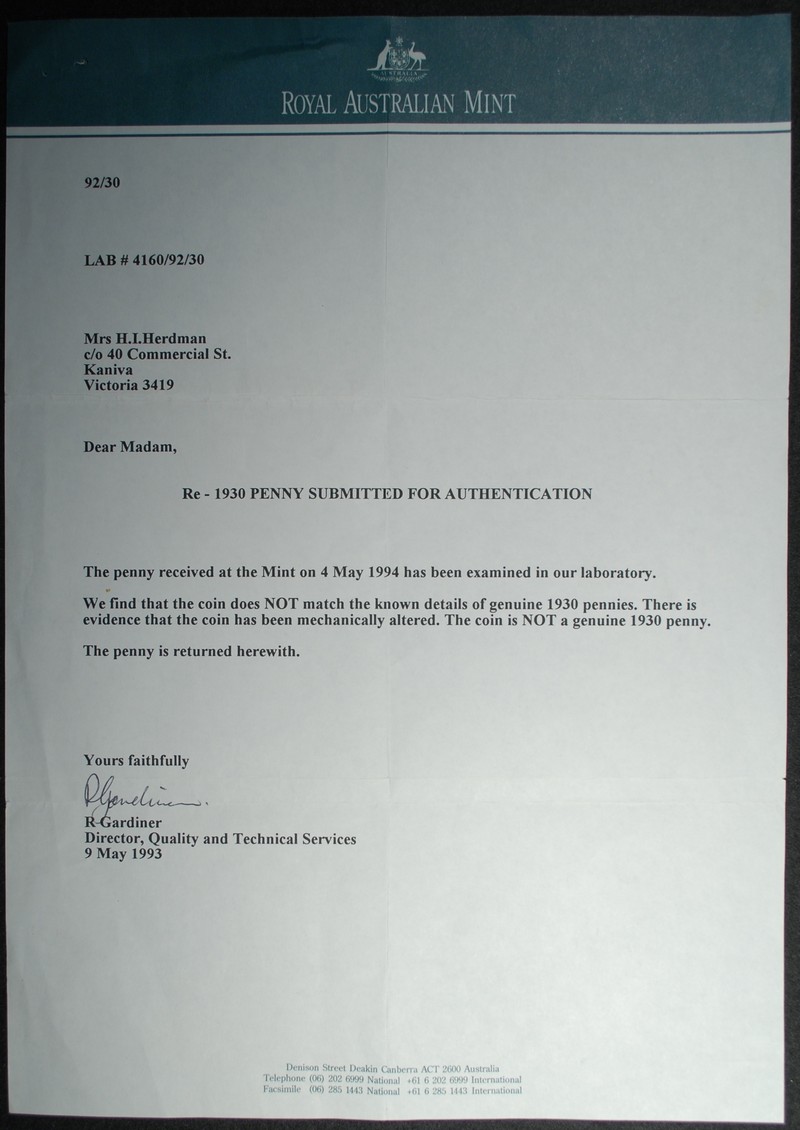
In the past, those with the intent to deceive have taken an Australian penny from another year and changed the date to make it appear as a 1930 coin. Whilst this isn't an offense, it becomes so when this coin is attempted to be passed off as a real 1930 penny. This type of coin is called an 'altered date' penny. Now this altered date type is the only 1930 penny I'll ever be able to afford and it comes with a letter from the Royal Australian Mint advising as such. A collector in the past sought advice from the experts, which the Mint used to do for a fee, and appraised the coin to determine if it were genuine. The letter of advice is seen below.
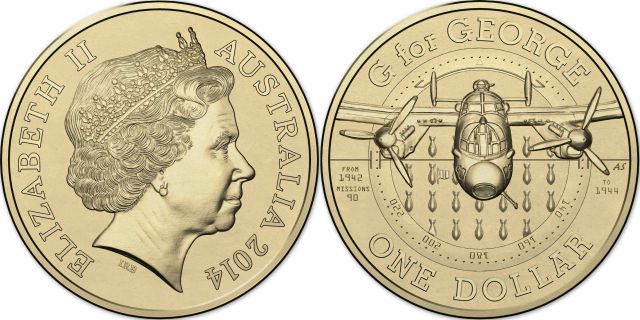
The 2014 G for George $1 Coin (image courtesy the RAM)
G for George is an historic Australian war plane that can be found on display at the War Memorial in Canberra. It is a four engined Avro Lancaster bomber that flew for the Australian 460 Squadron over German occupied Europe during World War 2 from 1942 to 1944. During this time it flew 90 missions, the second most of a surviving Lancaster bomber before it retired in 1944. It is somewhat remarkable that during the 90 missions every crew member returned alive. After retirement it was overhauled and flown back to Australia by an all Australian crew. When back in the country it embarked on a war bond tour of the eastern states of Australia before being retired from service in 1945 when it was donated to the Australian War Memorial.
The retirement of G for George happened after it flew a last active mission which was to bomb Cologne in Germany on 20 April 1944. It's now 70 years since this event and to mark it the Royal Australian Mint has released a 25mm, 9.0 gram aluminium bronze uncirculated dollar. The coin is not to be released into circulation and is available to collectors in an information card with the coin housed in a capsule. The information card displays the registration number of the aircraft (W4783) and 90 bomb symbols representing the 90 combat missions the aircraft undertook. These same symbols are painted on the side of the aircraft itself and can still be seen on G for George in ANZAC Hall at the AWM in Canberra.
The coin itself bears the usual Ian Rank-Broadley portrait of Queen Elizabeth II on the obverse. The reverse of the coin was designed by Aleksandra Stokic. It bears the legend "G for George" and "One Dollar" and some small notations indicating when the bomber was active and how many missions it undertook. There is an excellent front-on representation of a Lancaster bomber that dominates the centre of the coin against a background showing stylised bomb silhouettes. The aircraft and bombs are enclosed by a circular frame that represents the dial of a compass.
Mintage of the coin is intended to be 30,000 coins and the price is $13.50. At the time of writing the coin was still available for purchase from the Royal Australian Mint website. This interesting military themed coin is part of the RAM's ANZAC Centenary Coin Program and is likely to be a popular one to collect as military themed coins usually are. Depicting an aircraft of such historic significance is likely to make the coin of some appeal to aircraft aficionados, students of military history, and of course coin collectors.
Perhaps you've been digging in the garden and turned up a silvery coin, about the size of a 20 cent coin. Or maybe you're at your grandparents and they've given you some coins to look at and among them are some unfamiliar looking coins, again the size of a 20 cent. One side has a kangaroo and emu facing each other across a shield. Above or below the kangaroo and emu might be the word "florin" and a date. The other side has the portrait of a young woman, or perhaps a man. If it's a man he might be bare headed or he might have a crown. What you've got in your hands is a florin.
Florins, are 20 cent sized silver coins that also weigh the same as a 20 cent coin (11.3 grams). Florins circulated in Australia before we changed over to decimal currency in 1966. They were worth two shillings and were known as "two bob", 10 florins made up a pound and there were 24 pennies to each florin. Back in 1960 the average wage was nearly 18 pounds and a loaf of bread cost 18 pence, so one florin would buy you a loaf of bread and give you sixpence change. Compare that to 2013 where the average cost of a loaf is $3.00 and you get the idea that this one silver coin had the purchasing power of nearly $4 in 1960. So if you've found some old Australian florins you're probably wondering what are they worth? Well here's what you need to do to work that out.
Don't Clean Them
This may seem a little strange but the first thing you can do to determine the value of your florins is to under no circumstances clean them. But, I hear you say, they are dirty and grotty and they'd look so much nicer if they were shiny. Well, you might think that, but coin collectors being the funny lot they are LOVE coins in original condition. And once you clean a coin it's no longer original and it's not as attractive to them. One careless scrub with your dish scourer can instantly turn a florin that might be worth $50 to a coin collector into a $4 coin that's only fit for the silver melt bucket. So, let me say it again, DONT CLEAN YOUR OLD FLORINS.
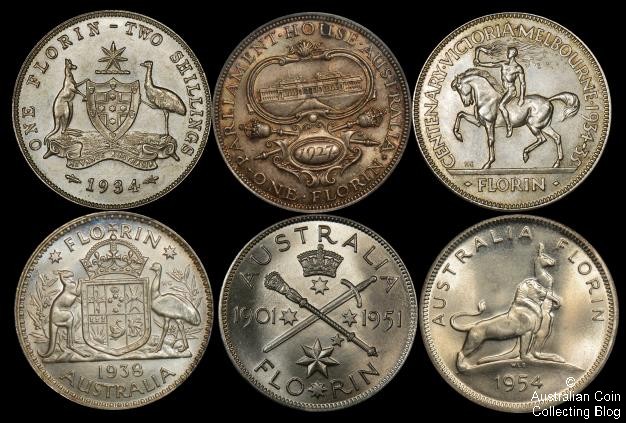
Australian Florin Reverses
Sort Them Into Two Piles By Date
If you're lucky enough to have more than one florin then you need to sort them into two piles. Look for the date on each coin, it will be on the side with the kangaroo and emu and at the bottom of the coin. Above I've (rather helpfully) created an image of the reverses (or tails sides) of all the Australian florins you're likely to see. Note that usually the date is at the bottom but on some of the commemorative coins (the ones with the different designs) the date moves about a bit.
Anyway, back onto sorting the coins. On your left, make a pile of all the coins with a date BEFORE 1946. On your right make a pile of all the coins with a date with 1946 and later. Once you're done sorting look at the two piles. The one on the left is 92.5% silver (also known as sterling silver) and those florins are known as "pre" florins. The one on the right is 50% silver and those florins are known as "post" florins. So, if nothing else the old florins you've found are worth something in silver. How much exactly? Well, the "pre" florins have about 1/3 of an ounce of silver in them and at the time of writing (May 2014) they were worth AU$7.09 each. And the post florins? They have 0.1818 of an ounce of silver in each one and at the time of writing they were worth AU$3.83 each.
You're probably thinking, great, these florins are actually worth something just because of the silver in them! And, yes, that is great but before you rush off to the local silver merchant to have them melted down we need to take a MUCH closer look at the dates on each coin.
Look at the Dates On the Left Pile
Some florin dates and designs are worth more than others. Usually this is because of lower mintages and some other factors that we wont bother going into now. Examine the dates of each coin in the pile to your left (they are the ones dated BEFORE 1946). Put aside any of these dates:
- 1910 Florin
- 1914H Florin
- 1915 and 1915H florins
- 1932 Florin
- 1933 Florin
- 1934-5 Centenary Florin
- 1939 Florin
If you find any of those then congratulations they are all worth MORE than the silver they contain. Mostly at least DOUBLE the silver content. And if you're really in luck and one of those old florins is dated 1932 then you've really scored. Those coins are worth at least $100 regardless of how worn they are. If you're STUPENDOUSLY lucky then you've found a florin dated 1934-5 that looks very different to the others, showing someone riding a horse on the tails side of the coin rather than the usual kangaroo and emu. These are Centennial Florins and usually worth at least $200-$300 regardless of condition. In the earlier image of the tails sides of all the Australian florins the Centenary Florin reverse is the one at the top right.
While you're looking at your "pre" florins it's highly likely that you'll see some that have a picture of a building on the "tails" side of the coin and are dated 1927. These are known as Parliament florins and were the first commemorative coins issued in Australia. You'll probably notice that the guy on the "heads" side of these 1927 coins looks a little different to all the others too. If you look at the image below you can see the "heads" side of Parliament florins at the top right. Despite being pretty coins Parliament florins are, a bit sadly, usually only worth the silver they contain unless they are in "mint" condition. Mint condition is basically what a coin looked like the day it was made. And don't go thinking that giving a coin a quick polish to make it shiny restores it to "mint" condition. This polishing is easily picked by experienced coin collectors and dealers and your polish has effectively ruined the coin.
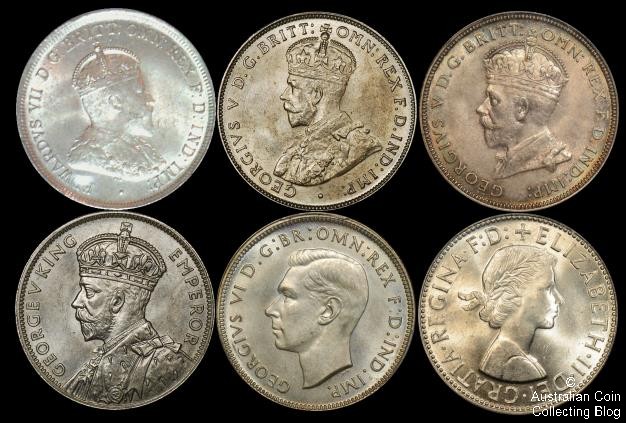
Australian Florin Obverses
Look at the Coins on the Right Pile
For "post" florins the date is not really the determining factor in the value of the coin. It's what's known as "condition" or "grade". If a "post" florin is uncirculated then it can be worth more than the silver it contains. If it's not, well almost all of them are really only worth the silver content. How can you tell the grade of a florin? Well, that's not an easy topic that can be explained in this article. I'd suggest taking them to a reputable coin dealer and asking him or her to offer a grade on them. Some dealers won't do this for free though. Or alternatively look at the coins they are selling and compare yours to those. Another option is to take good clear images of the coins and post them up onto a coin forum for Australian coins or maybe even our own Facebook page and ask for a grade. If you're lucky people will offer you an opinion on both grade and potential value.
There's one warning I must give about grading. It is a difficult art and just a few blemishes that are not even noticed by the coin grading novice can render what you believe to be a pristine coin into a coin only fit to be sold for silver value and sometimes this is difficult to pick in hand or from a photo or image.
What Next?
If you've got to this point you'll have put aside any coins that are worth more than the others and you'll have a pile of "pre" and "post" florins that we'll call "bullion florins". You can work out what the silver value of the "bullion florins" is by using our silver coin calculator here. Remember though, if you try to sell those coins to a coin dealer or silver merchant they won't offer you the full silver value, because they need to make a profit. If you try selling them on an online auction site (like eBay) you might get the full silver value but of course you'll need to pay the auction site fees.
So what about the other dates that we've decided are worth more? Well the values of those is almost entirely dependent on the grade. As I've said already you can get grade opinions from coin dealers or online forums. But remember opinions are just that, opinions, and will only serve to give you some idea of the value of your coins. Another option is to buy an Australian Coin Catalogue and armed with that and some grading skills you can get some idea of value. Let me give you two great big tips though. First, the values in coin catalogues are RETAIL VALUES and you'll almost never get offered those prices if you try to sell your coins. Actually if you try to sell coins to a dealer you'll be lucky to get HALF of what the values are in a a catalogue.
Second, coin catalogues include prices for coins known as "specimens" and "proofs" and for Australian florins the values of those can have as many digits as phone numbers. Those values can be alluring and it's tempting to think that the florins you've found are "proofs" or "specimens" but they almost certainly are not. Nothing will upset a coin dealer more quickly and thoroughly when you're trying to sell some coins to him and you insist that they are proofs or specimens in an attempt to get more for your coins. It won't work so don't try it.
If you decide to sell your found florins to a coin dealer they'll grade them for you and give you an offer for them. But, again, remember they need to made a profit so don't expect to get rich. If you want to try selling them yourself using an online auction site then take good clear images of the coins and list them up and let the market decide their grade and value.
I Don't Want to Sell My Florins, I Want to Keep Them!
If you decide to keep your florins then great, welcome to the world of coin collecting. I strongly suggest read our coin storage recommendations. It would be a shame to have spent all this time working out the florins you found are worth real money and then to have them ruined by choosing the wrong storage system.
Last weekend on the 24th and 25th of May saw an ANDA Coin and Banknote Show being held in the Brisbane Table Tennis Centre. For those who are interested in stamps this year the show was held in conjunction with the Australian Philatelic Traders Association and there were a few more stamp dealers in attendance than is usually seen at the average ANDA show. Unfortunately only one of the blog authors managed to attend this show, which isn't what we like to do usually. It's always great to have a friend along to talk to and to make sure the coin you're about to buy isn't a dud. Travelling alone also meant that it was a fly-in-fly-out show, with a 6:00AM flight on Saturday leaving Adelaide for Brisbane and not touching down again in Adelaide until well after 10PM the same day.
I like the Table Tennis Centre as an ANDA show venue. It has been used for the Brisbane ANDA shows for a few years now and it's easy to get to from both the airport and the city. The front door was manned (personned?) by voluneers from various Queensland coin and stamp clubs (such as the Queensland Numismatic Society) and admission for one day was $10. Once inside dealer tables were well laid out with plenty of seating and aisle space and the lighting was excellent There was a cafeteria selling food and drinks at reasonable prices (I got a sandwich and a drink at lunch time for $7.50) and staffed by volunteers from the table tennis centre. At one end of the venue was a bank of seating, usually used to watch table tennis action but in the case of this show, well used to rest the weary legs of show visitors. My only gripe about the center is that it's not well air-conditioned and it was a little hot and humid inside this year. That being said most capital cities in Australia are unseasonably warm right now so perhaps if the weather wasn't so messed up it wouldn't have been so uncomfortable inside.
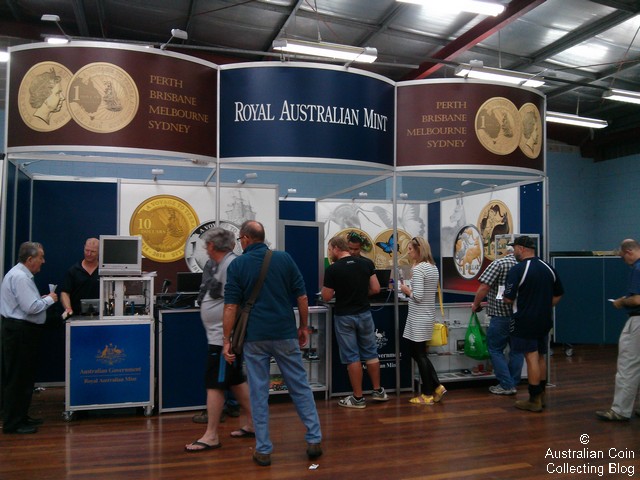
The Royal Australian Mint Stand
The Royal Australian Mint was in attendance this year and the RAM brought their portable press along, where for $10 you could press the button and counterstamp your own Voyage to Terra Australis dollar. According to the press operator the coin is supposed to have a mintage of 7,500 and no doubt will be distributed through the RAM dealer network. Never fear, if you didn't attend the show it won't be too hard for you to buy one of these coins. As well as the portable press the RAMfolk also brought along their usual array of NCLT and I am somewhat shamefaced to admit that I bought some of it. Including the new high relief 1 ounce mob of roos silver dollar and the pad-printed copper nickel mob of roos dollar. They are both pretty coins and interesting variations on the iconic circulation coin design minted for the 30th birthday of the Australian 1 dollar coin.
According to the ANDA Showguide I brought home with me there were another 41 dealers in attendance at the show and I can believe it. All tables had a dealer standing behind them and all of the tables were full of stock. If you came along to the show and didn't find something to buy then you either were not looking hard enough, are extremely picky, or are completely broke. Apologies at first to the stamp dealers because I didn't look at any of their tables so I cannot comment on who was or wasn't there. Local Queensland coin dealers of note that I recall include VP Coins, Global Coins & Banknotes, Roxbury's Auction House, Gold Coast Coins and Stamps, International Auction Galleries, Colonial Coins and Medals, David Rider Numismatics, and Claude Andresco Coins. Dealers who had made the trip from interstate included Sterling & Currency, Pacific Rim Coins, Australian Coin Auctions (Downies), Prospect Coins, Universal Coin Company, and Canberra Numisco. Particular credit must go to Andrew Crellin (of Sterling and Currency) who, having travelled the farthest of all dealers in attendance (from Western Australia) still had an amazing range of material to look at. I bought a couple of things off of him and I appreciate the effort he took to bring some specific coins for me to look at.
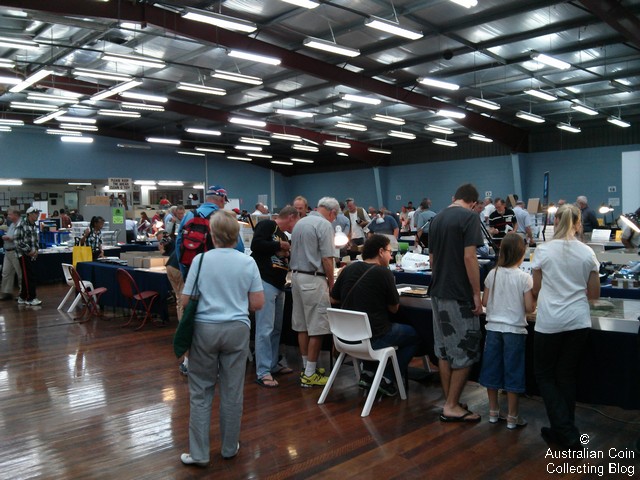
Big Crowds
Attendance before about 1.30PM was extremely strong and for the first time in a long time at an ANDA show I had to fight for a spot to sit and look. And amazingly it seems that people didn't just come to get their coins from the RAM, with most dealers reporting to me that their sales had been good. The types of coins being sold seemed to cover the full gamut, ranging from recent release NCLT, Australian decimal singles, modern world coins, quality Australian pre-decimal, and pricey errors and ancient coins. This doesn't surprise me though, as I believe it's a buyers market right now, especially for collectors of premium (and scarce) material. This idea was backed up after the show when I was talking to a very well known Australian numismatic identity. He suggested that now was the time to be snaffling up coin (and banknote) rarities with an eye to future long-term returns. For those (like me) who do not look to buy items from the top end of the market there were still bargains to be had for those on a lower budget. For example, the bottom has really dropped out of the Australian mint and proof set market and if you're looking to complete your run of sets now is the time to do it.
Given that we are strong supporters of third party graded coins (in particular those graded by PCGS) I should comment on their representation at the show. Chris Buesnell of Pacific Rim Coins had cases full of slabbed coins as did Sterling and Currency and Universal Coin Company. IAG and Monetarium Adelaide had some rarities in PCGS and NGC slabs and I noticed a few dealers with graded bullion coins (such as Kookaburras, silver kangaroos, and American silver eagles). Graded coins seemed to be primarily the domain of the "bigger" dealers though with very few of the local Queensland dealers having any at all. One comment I have to make though is that this is the first show in a long time where the discussion I had with show attendees regarding third party graded coins was entirely positive. Perhaps the collector market is starting to see the advantage of getting their coins graded and certified by companies such as PCGS and NGC.
That's another ANDA show report done and dusted. Thanks to everyone in Brisbane who I met and talked with. Thanks to the members of the Australian Coin Forum who I met at the show and in particular to the forum member in the Pac-Man hat that made him easy to find. And thanks of course to my fellow blog author who stayed home in Adelaide and manned (personned?) the battle stations while I was in Queensland looking at coins. Both of us will be attending the next ANDA show in Melbourne in early August so stay tuned for another riveting show report coming your way soon!
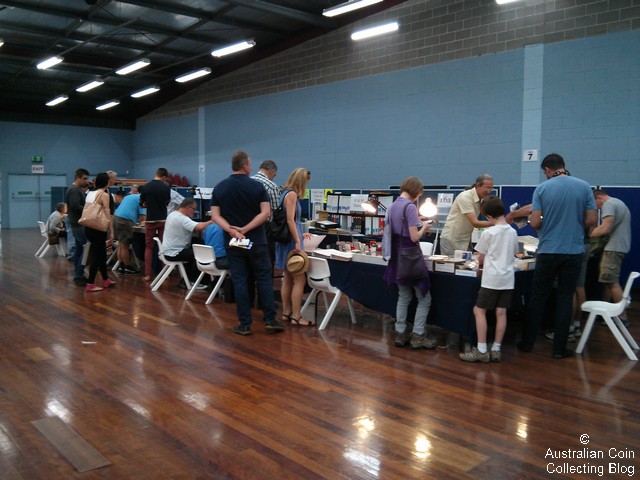
More Crowds
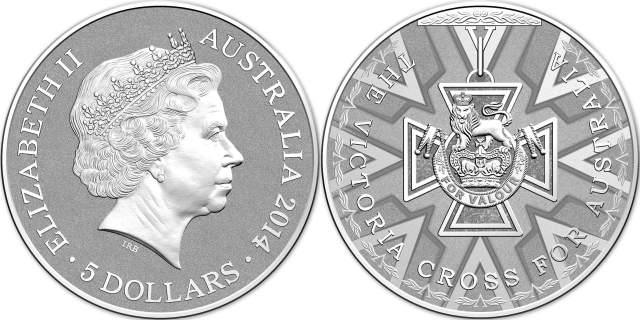
Silver Victoria Cross 5 Dollar Coin (image courtesy www.ramint.gov.au)
If you've ever watched ANZAC Day parades, commemorating the Gallipoli landing of 1915, you would have seen squadrons, platoons, companies, regiments, marching bands - a whole range of armed forces - proudly marching and displaying their medals. Even more noticeable, as war veteran numbers dwindle, are the family members who are also proudly displaying their relatives' medals.
Did you know that there's a protocol for the correct wearing of medals? Medals displayed on the left breast indicate the true owner and actual recipient of the medal, with the ownership of those medals remaining with that person, even in death. When medals get passed down to the next generation, those medals can only be worn on the right breast.
The highest military honour introduced by Queen Victoria on 29th January 1856 for "valour in the face of the enemy" during the Crimean War, is the Imperial Victory Cross medal (Imperial VC). And it ranks higher than all other orders, decorations and medals. Even the most senior military officer must salute a VC recipient, no matter what rank, as a mark of respect.
In 2000, the Royal Australian Mint released a memorial coin to mark the 100th Anniversary of the first Imperial Victoria Cross awarded to an Australian. The medal was awarded on 24th July 1900 to Major General Sir Neville Reginald Howse VC KCB KCMG for the rescue during the Boer War of a wounded man, despite being under attack himself.
To date, the Imperial VC has been awarded 1,357 times - with only 14 being awarded since the Second World War - 10 within the British Army and 4 within the Australian Army. However, since 1856 to current day, 100 Australians have been awarded the Victory Cross, and to mark this historic occasion, The Royal Australian Mint recently released (via ballot) a $10 antique copper coin (limited to 5,000). The coin is part of their Anzac Centenary Coin program, with the VC recipients names displayed in micro text.
The Victory Cross for Australia was introduced in 1991, replacing the Imperial VC awarded to Australians and is now the highest Australian military award. The wording for this award is "other persons determined by the Minister [for Defence] for the purposes of this regulation" - in essence not restricted to members of the Australian Defence Force but possibly open to police personnel and even civilians.
The Victory Cross for Australia has been awarded four times:
??? In 2009, to Trooper Mark Donaldson of the Special Air Service Regiment, who rescued an interpreter under heavy enemy attack in Oruzgan province, Afghanistan on 2nd September 2008.
??? In 2011, to Corporal Ben Roberts-Smith MG of the Special Air Service Regiment, after destroying two Taliban machine gun placements, during the 5-day Shah Wali Kot Offensive in Kandahar province, Afghanistan on 11th June 2010.
??? In 2012, to Daniel Keighran of the 6th Battalion, Royal Australian Regiment for drawing enemy fire away from an injured colleague and those tending to his injuries, in the Battle of Derapet in Oruzgan province, Afghanistan in August 2010.
??? In 2014, posthumously to Corporal Cameron Baird MG of the 2nd Commando Regiment, who was killed in Afghanistan in 2013 and previously awarded the Medal for Gallantry in 2007, for his part in a Taliban stronghold search and clearance operation.
Also part of the Anzac Centenary Coin program, the Royal Australian Mint has now released a five dollar 1 ounce fine silver frosted uncirculated coin to commemorate the 100th Australian receiving the VC (combined total of both the Imperial VC and the Victoria Cross for Australia). The reverse coin design depicts the Maltese Cross, with a lion guardant above a crown symbolizing the British Royal Family. The obverse depicts the portrait of Queen Elizabeth II, designed by Ian Rank-Broadley. The coin is issued at $70 with a capped mintage of 30,000 coins.
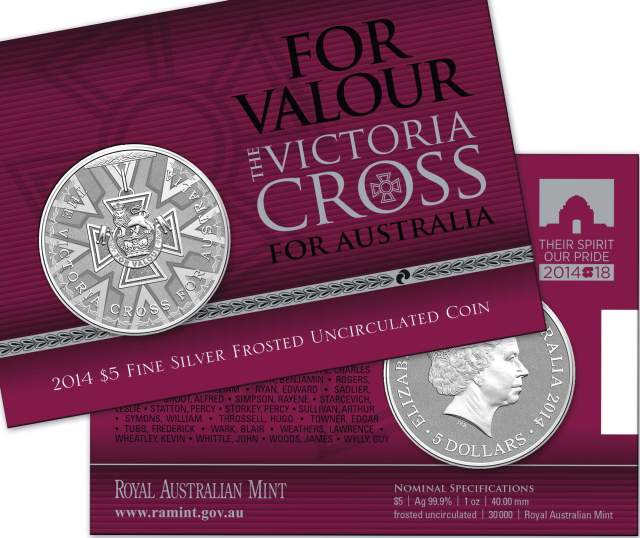
1oz Silver Victoria Cross $5 Coin in Pack (image courtesy www.ramint.gov.au)
Right now all circulating Australian coins are made of two different metal alloys. 5 cent, 10 cent, 20 cent, and 50 cent coins are silvery grey in colour and made from an alloy of 75% copper and 25% nickel. This alloy is typically referred to as Copper/Nickel or sometimes CuNi. The other two coins you're going to find in your change the one dollar and two dollar coins and are pale gold in colour. These are made from alloy of 92% copper and 8% aluminium which is called Aluminium Bronze or AlBr.
Were Australian Decimal Coins Ever Made of Other Metals?
If you're about 30 or older then you probably remember when one and two cent coins circulated in Australia. These coins were introduced in 1966 (along with the other decimal coins) and were withdrawn from circulation in early 1992. They were bright shiny orange when new and became a dull dark brown as they aged and were heavily circulated. Both the one and two cent coins were made from a bronze alloy which is 97% copper, 2.5% zinc and 0.5% nickel.
The other decimal coin that was made of a different material is the fifty cent coin. The current 50 cent coin as we know it has a distinctive dodecagonal 12 sized shape and was first released into circulation in 1969. However, when decimal coins were unleashed on Australia in 1966 the 50c coin was round and was an alloy of 80% silver and 20% copper. More than 36 million of them were minted and each contained nearly a third of an ounce of silver. Because of their silver content the intrinsic value of the metal they contained quickly outstripped the face value and they were hoarded in huge numbers by the Australian public. Because it was actually a loss making exercise to make the round fifty cent coins the government only made them for 1966 and rapidly withdrew them from circulation. You're not likely to find a round fifty cent in your change but you've probably heard of them because they have achieved something of a legendary status among the Australian public.
Are Decimal Collector Coins Made from Other Metals?
The Royal Australian Mint (RAM) and the Perth Mint release a large number of coins for the collector market every year and have done so for many years. These coins, while technically legal tender, are not really intended to be used as money and are known as non circulating legal tender (NCLT). Australian collector coins have been made from almost every metal you can think of, including platinum, gold, silver, copper nickel, aluminium bronze, bronze, and copper. To work out what metal your collector coin is made out of you could Contact Us and describe your coin or you could go to your library and borrow a coin catalogue and look it up yourself.
What Were Australian Coins Made From Before Decimal Coins?
Before Australia moved to the decimal system in 1966 we were in what is known as the "pre-decimal" era and our coins used the pounds, shillings, and pence (£/s/d) system. Denominations minted for Australia from 1910 through to decimal changeover were the half penny, the penny, the threepence, the sixpence, the shilling, the florin, and the crown. The half penny and penny coins were made from the same bronze alloy that one and two cent coins were made from. Crowns (5 shillings) were only minted for 1937 and 1938 and were made of sterling silver which is 92.5% silver and 7.5% copper. Any threepence, sixpence, shilling, and florin dated BEFORE 1946 was also made from sterling silver. Australian silver coins dated from 1946 to 1964 were minted from an alloy known as "quaternary alloy" which is made up of 50% silver, 40% copper, 5% zinc, and 5% nickel.
Like the 1966 50 cent coins I mentioned earlier Australian silver pre-decimal coins have an intrinsic value above and beyond their face value. You can work out what the value of the silver they contain is by using our silver coin calculator here.
Are Australian Coins Ever Going to be Made of Other Metals?
While we can't say for certain there's at least some chance that our coins could be made of other metals at some stage in the future. The main reason for this would be to reduce the cost of manufacture of the coins. The difference in the cost of materials and manufacturing for a coin and it's actual face value is known as "seignorage" and obviously the government likes to maximise this profit. Australia's close neighbour, New Zealand, used to have circulating decimal coinage of the same size and composition as ours. But in 2006 they produced a new series of coins that were both smaller than the preceding decimal coins and made of different materials. This helped them realise a significant cost saving and resulted in a smaller, easier to understand coinage that has been widely accepted by the New Zealand public. Common sense dictates that Australia could follow the same path with our decimal coins at some point.
It you're new to coin collecting in Australia then you're probably aware by now that most Aussie collectors collect pre decimal coins in one form or another. It wouldn't surprise me though, if you're not exactly sure exactly what makes an Australian coin a pre-decimal. And that's not actually too unusual because it's now rapidly approaching 50 years since the pre-decimal coin era finished. I'm 43 and I have exactly zero memory of seeing any pre-decimal coins in circulation.
So What is an Australian Pre-Decimal Coin?
The most generally accepted definition is that an Aussie pre decimal coin is any coin that was minted for circulation in Australia and is dated between 1910 and 1964. Pre-decimal coins were minted for Australia during this period in Australia itself (in Sydney, Melbourne, and Perth), in Great Britain, in India, and in the USA. Coin denominations minted were the halfpenny (1/2d), the penny (1d), the threepence (3d), the sixpence (6d), the shilling (1s), the florin (2s), and the crown (5s). There were three basic units of currency, the pound (£), the shilling (abbreviated with an s), and the penny (abbreviated with a d). Two half pennies made up penny. There were 12 pennies to the shilling and 20 shillings to the pound (£) sterling. Thus there were 240 pennies or 10 florins to each pound.
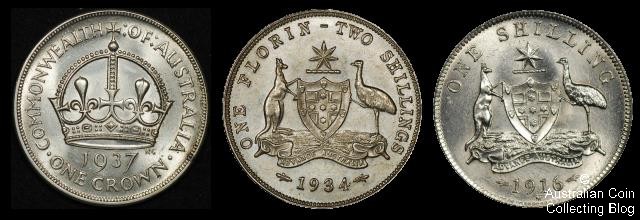
Reverse Designs of the Crown,Florin, and Shilling
Coins were minted in Bronze (the penny and half penny) and in silver alloy (threepence, sixpence, shilling, florin and crown). The silver coins had what is known as an intrinsic silver value due to the silver bullion each coin contained. The exact silver value of each coin depended on the year it was minted as silver coins dated prior to 1946 were minted in an alloy that was 92.5% silver while those dated from 1946 to 1964 was a 50% silver alloy. The bullion value of silver pre decimal coins is easily worked out using this calculator.
The design of our pre decimal coins did not remain stagnant. The obverse (or heads) design changed each time the reigning monarch of England changed. Portraits of Edward VII, George V, George VI, and Elizabeth II adorned the coins at one time or another. In addition, commemorative florins issued in 1927 and 1934 had slightly different portraits of King George V than what was seen on other coins. The reverse (or tails) side of pre-decimal coins underwent a major redesign in 1938 and 1939. The reverse designs of all the coins except the halfpenny changed in 1938 and that coin changed in 1939. The exception here is the crown (or 5 shillings) coin which was only minted for 1937 and 1938 and the design was the same both years.
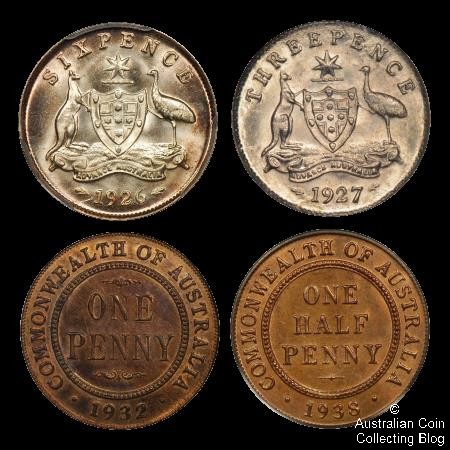
Reverse Designs of the Sixpence, Threepence, Penny, and Halfpenny
On February 14, 1966 the pre-decimal era finished in Australia and the decimal era of dollars and cents began. While it's nice to think that there was an instant change the reality was that pre decimal coins were assigned an equivalent value in dollars and cents and continued to circulate for a number of years after 1966. But the numbers dwindled fairly rapidly. My parents tell me that while it wasn't common, it wasn't actually that unusual to see florins in your change until the mid 1970's.
What about Sovereigns and Half Sovereigns?
If it was up to me I'd include Australian minted gold sovereigns and gold half sovereigns in the definition of what makes up an Australian pre decimal coin. Both coins are 22 carat gold. Half sovereigns contain a bit under an eighth of an ounce of gold, are about the size of a modern five cent coin and were valued at half a pound or 10 shillings. Sovereigns are twice the weight of a half sovereign containing fractionally under a quarter of an ounce of gold, were valued at a full pound (or 20 shillings) and are a couple of millimeters in diameter smaller than a ten cent coin.
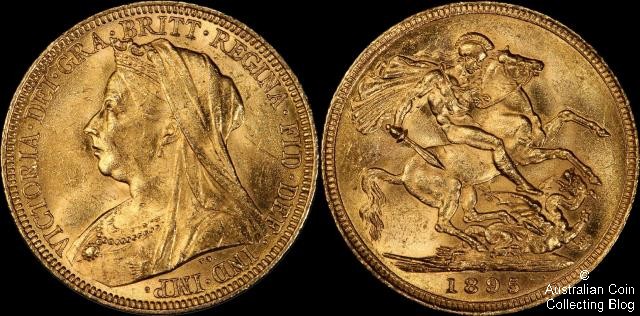
An Australian Gold Sovereign
Sovereigns and half sovereigns were minted for circulation in Australia from 1855 until 1919 (in the case of halves) and 1931 for the full sovereigns. During this time they were minted at the Australian branches of the Royal Mint in Sydney, Melbourne, and Perth.
What I'm Not Including in Pre-Decimal Coinage
I'm going to exclude any English coinage that might have circulated in Australia in the second decade of the 20th century and prior to this period. While British coins did circulate here in that period they are not intrinsically Australian and cannot be classified as Aussie predecimals. To my mind these coins are British and should be collected as such. Of course they could easily be included in a collection of "coins that circulated in Australia".
I'm also going to exclude colonial coins such as Adelaide Pounds, Assay Office Ingots, traders tokens, Taylor gold tokens, holey dollars and dumps, and proclamation coins. While it could be argued that all of these coins are "pre-decimal" because they were valued in pounds, shillings, and pence I believe they fit neatly into another category of collecting. That of Australian Colonial coins and Proclamation Coins.
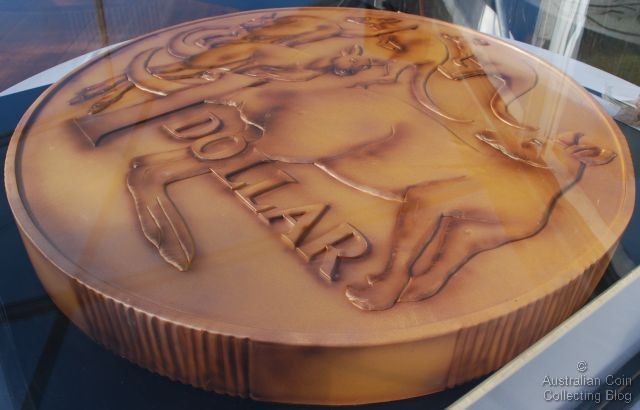
Let there be cake! The Mob of Roos One Dollar Cake at the Mint for the 2011 Product Launch
It's the 30th birthday of the iconic Stuart Devlin design 5 kangaroo dollar coin affectionately known as the "Mob of Roos". Open your wallet and you'll immediately pick out the attractive and timeless design coined by the master silversmith and designer of the echidna 5c, lyrebird 10c, platypus 20c and Coat of Arms 50c.
The Australian dollar coin was brought to life on May 14th 1984 when a coin replaced the dollar note. Our first "gold coin" to spend is actually struck in aluminium bronze with a gold appearance. The dollar proved extremely popular and has been struck with many many (many many) commemorative designs over the years, a browse through change will show you a sample of just how many there are from celebrating The International Year of Peace (the first commemorative in 1986), memorable Australians Sir Henry Parkes, Sir Charles Kingsford Smith, The centenary of Scouts, Girl Guides and APEC and CHOGM. The Royal Australian Mint has also struck many dollar coins that haven't entered circulation, coins specifically struck for collectors. Examples of these include a myriad of War related issues, various coloured birds and animals, the 75th anniversary of the Sydney Harbour Bridge, Blinky Bill, the Magic Pudding and the Steve Irwin dollar.
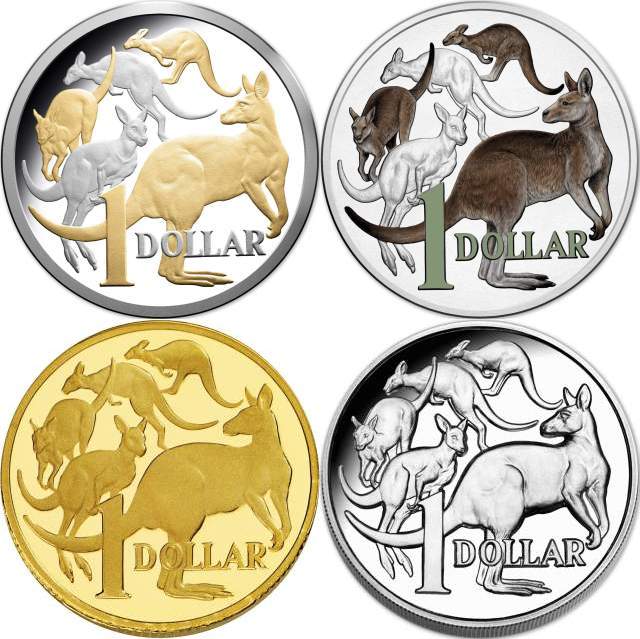
Proof Set Dollar (top left), Mint Set Dollar (top right), Wedding Set Dollar (bottom left) and High Relief 32mm Silver Proof (bottom right).(image courtesy www.ramint.gov.au)
The most popular is those 5 kangaroos and for the 30th birthday in 2014 the Mint has released some very special coins in commemoration. The normal standard 25 millimetre mob of roos struck on an aluminium bronze planchet can be found "tarted up" for this event. A coloured mob is found struck on an aluminium bronze planchet in the Mint Set. The proof set features a copper nickel planchet with gold plated kangaroos. The standard coin is also being counterstamped at various pop-up Mint shops in some capital cities. A larger (32mm) high relief silver mob can be found specially boxed. For more information on the various issues please see 2014 Australian Dollar Coins Issues and Mintages, as a dollar collector myself the plethora of issues even confuses me!
It was first reported in 1982 that government was to be going ahead with replacing the $1 note with a coin. It just made sense to replace a paper banknote with a lifespan of just 8 months with a coin you can still find in your change today 30 years later (yes, go and take a look!). The blanks among the first sourced from South Korea when the local supplier couldn't provide the quality of aluminium bronze alloy needed. This added to disruption at the Mint with industrial action prevalent around this time.
D Day or Dollar Day was 14th May 1984 and banks were instructed to return ALL dollar notes (even new one's) as soiled to the Reserve Bank to decrease the dual currency period. Before this date the dollar coin was not legal tender but some dollars sneaked out and were found in Brisbane and Sydney in early April 1984.
The distribution of coins by the Royal Australian Mint was the largest since the changeover to decimal currency in 1966. Convoys of semi-trailers travelled to various locations of the Reserve Bank with each semi carrying $10 million. These were escorted by plain clothed armed Commonwealth Police and was completed by March 1984 ready for D-Day. With all the fuss of the $1 coin, the birthday of the first $100 note on March 26th was completely overlooked!
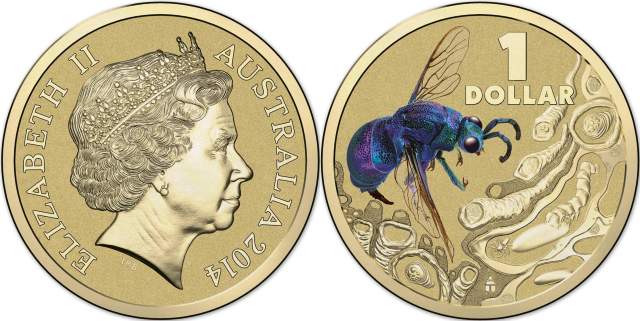
Pad Printed Colour Cuckoo Wasp Australian Dollar Coin in the Bright Bugs Series (image courtesy www.ramint.gov.au)
We all know about the Cuckoo Bird, don't we? They don't build their own nests, they lay their eggs in other bird's nests, and once hatched, the baby Cuckoo Bird pushes the "host" eggs out of the nest and takes over the nest for itself.
What if I told you that there's an insect that behaves just like the Cuckoo Bird? And would you be surprised to learn that it's name is the Cuckoo Wasp?
The Cuckoo Wasp belongs to the Chrysididae family and there are 76 different species within Australia. They are also commonly called the Emerald Wasp due to their iridescent green, blue or purple colouring. Their habitat is in the urban areas, forests and woodlands of Australia, most commonly found in Queensland and they feed on nectar. The Cuckoo Wasp is one of the six coins in the recently released Royal Australian Mints "Bright Bugs" series of one dollar coins.
This wasp lays it's eggs in the nests of other insects, most notably those wasps that build mud-nests in and around human habitation. For that reason, you've probably seen this brightly coloured wasp in and around your own home.
Once entrenched in a "host" nest, most Cuckoo Wasp's eggs will hatch first, with the larvae then feeding on the stored food left in the nest for the "host" larvae. However, the most likely scenario is that the Cuckoo Wasp larvae will actually feed off the "host" eggs or larvae. There are some Cuckoo Wasp eggs though that won't hatch until the "host" eggs have hatched and had their first meal. Then the Cuckoo Wasp eggs hatch, attacking and devouring the "host" larvae. Quite an ingenious but deadly method to ensure their survival.
As the "host" nest is invariably another wasp's nest, the female Cuckoo Wasp needs to defend itself if it's discovered when invading another wasp's nest. To avoid being stung, the Cuckoo Wasp rolls itself up into a tight ball so that it's external "armour" plates protect it from the other wasp's stings and biting mandibles. And as it's thought that the female Cuckoo Wasp doesn't sting, rolling into a ball is an effective defence mechanism. The long appendage that protrudes from a female's abdomen is in fact an ovipositor, used to insert and place it's eggs into the "host" nest.
The Cuckoo Wasp coloured $1 is pad printed with a frosted uncirculated finish and is one of the six coins minted by the Royal Australian Mint in the "Bright Bugs" series - a collection of 6 coins portraying "the prettiest bugs from around the country" with the catchy phrase "there's more to this bug than meets the eye".
The reverse of the coin depicts the Cuckoo Wasp's "life cycle" designed by Aaron Baggio - from a cross section of a "host" mud nest with a larvae attacking the "host" egg, through to the brilliantly iridescent adult Cuckoo Wasp itself. The obverse depicts the portrait of Queen Elizabeth II designed by Ian Rank-Broadley. This 25 millimetre aluminium bronze 9 gram 1 dollar coin is issued at $15.00 with a maximum mintage of 30,000 coins released.
Other coins in the 2014 Bright Bugs series released so far are the Ulysses Butterfly, Blow Fly and Stag Beetle. For up to date mintage information on this issue and other one dollar coins released in 2014 (the 30th birthday of the Australian Dollar Coin) see the 2014 Australian Dollar Coin Issues and Mintages table.
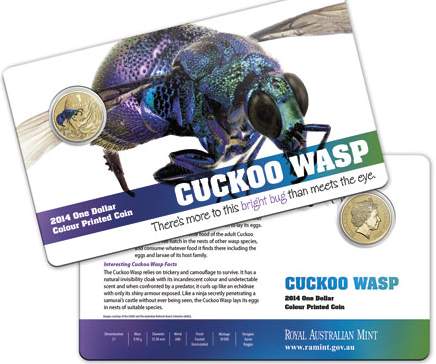
Cuckoo Wasp Australian Dollar Coin Packaging (image courtesy www.ramint.gov.au)