Coin News Archives
Those of you who entered the Royal Australian Mint ballot for the For Valour Victoria Cross Ten Dollar coin should now know if you were successful and hold the new release in your hand. If you weren't successful then you should have received confirmation and be on the waiting list for available coins if they aren't purchased by their selected ballot winner.
How long to hold onto such a coin is the biggest question given it's popularity. I'll go so far as to say this ballot is the most successful the RAM has run in recent times with interest from coin collectors, military enthusiasts far and wide and those who want to share in the Anzac centenary experience. From a small entry sample size of 3 in my own extended family we were successful in purchasing just one coin which agrees with the Mints statistics that they received 13,000 ballot entries for a coin with a 5,000 mintage.
For an outlay of $112 I was able to purchase one of these coins, and there was never a question that I would turn down the offer if given. I eagerly opened the box hoping with fingers crossed that I had received certificate number 100 (there are 100 VC recipients, their names on the coin). It wasn't to be, the coin, a stunning antiqued bronze beauty eagerly awaiting being held, loose in the box. Without a capsule the coin is asking to be held which is the idea behind it's manufacture. It's antiqued bronze finish and large medallion-like size intended to be a tactile experience for collectors, light handling not likely to affect the finish -just like you'd hold a Victoria Cross medal itself.
Should I hold onto this new coin is the next BIG question. A ten dollar coin doesn't, at all, fit into what I collect and they have proved poor investment purchases in the past. Many $10 silver decimal issues are generally traded well below their issue price at their silver content and don't hold a numismatic value. It's the theme here that has added to the success of this coin. Currently sales on auction site eBay see this coin selling for upwards of $600 with other website dealers allowing me to add 10 of these to my shopping cart at $699.99 (presumably that's an error and they don't have that kind of stock). You'd think though that once the excitement and hype has settled down so too will the price but time will only tell. This has been a good investment so far.
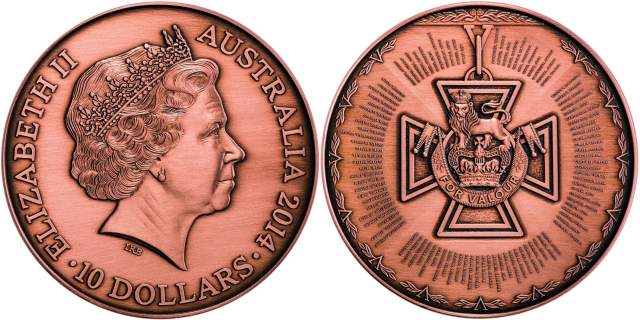
2014 Victoria Cross Ballot Coin (image courtesy www.ramint.gov.au)
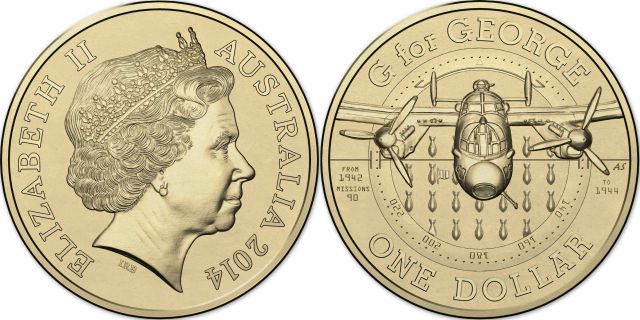
The 2014 G for George $1 Coin (image courtesy the RAM)
G for George is an historic Australian war plane that can be found on display at the War Memorial in Canberra. It is a four engined Avro Lancaster bomber that flew for the Australian 460 Squadron over German occupied Europe during World War 2 from 1942 to 1944. During this time it flew 90 missions, the second most of a surviving Lancaster bomber before it retired in 1944. It is somewhat remarkable that during the 90 missions every crew member returned alive. After retirement it was overhauled and flown back to Australia by an all Australian crew. When back in the country it embarked on a war bond tour of the eastern states of Australia before being retired from service in 1945 when it was donated to the Australian War Memorial.
The retirement of G for George happened after it flew a last active mission which was to bomb Cologne in Germany on 20 April 1944. It's now 70 years since this event and to mark it the Royal Australian Mint has released a 25mm, 9.0 gram aluminium bronze uncirculated dollar. The coin is not to be released into circulation and is available to collectors in an information card with the coin housed in a capsule. The information card displays the registration number of the aircraft (W4783) and 90 bomb symbols representing the 90 combat missions the aircraft undertook. These same symbols are painted on the side of the aircraft itself and can still be seen on G for George in ANZAC Hall at the AWM in Canberra.
The coin itself bears the usual Ian Rank-Broadley portrait of Queen Elizabeth II on the obverse. The reverse of the coin was designed by Aleksandra Stokic. It bears the legend "G for George" and "One Dollar" and some small notations indicating when the bomber was active and how many missions it undertook. There is an excellent front-on representation of a Lancaster bomber that dominates the centre of the coin against a background showing stylised bomb silhouettes. The aircraft and bombs are enclosed by a circular frame that represents the dial of a compass.
Mintage of the coin is intended to be 30,000 coins and the price is $13.50. At the time of writing the coin was still available for purchase from the Royal Australian Mint website. This interesting military themed coin is part of the RAM's ANZAC Centenary Coin Program and is likely to be a popular one to collect as military themed coins usually are. Depicting an aircraft of such historic significance is likely to make the coin of some appeal to aircraft aficionados, students of military history, and of course coin collectors.
Last weekend on the 24th and 25th of May saw an ANDA Coin and Banknote Show being held in the Brisbane Table Tennis Centre. For those who are interested in stamps this year the show was held in conjunction with the Australian Philatelic Traders Association and there were a few more stamp dealers in attendance than is usually seen at the average ANDA show. Unfortunately only one of the blog authors managed to attend this show, which isn't what we like to do usually. It's always great to have a friend along to talk to and to make sure the coin you're about to buy isn't a dud. Travelling alone also meant that it was a fly-in-fly-out show, with a 6:00AM flight on Saturday leaving Adelaide for Brisbane and not touching down again in Adelaide until well after 10PM the same day.
I like the Table Tennis Centre as an ANDA show venue. It has been used for the Brisbane ANDA shows for a few years now and it's easy to get to from both the airport and the city. The front door was manned (personned?) by voluneers from various Queensland coin and stamp clubs (such as the Queensland Numismatic Society) and admission for one day was $10. Once inside dealer tables were well laid out with plenty of seating and aisle space and the lighting was excellent There was a cafeteria selling food and drinks at reasonable prices (I got a sandwich and a drink at lunch time for $7.50) and staffed by volunteers from the table tennis centre. At one end of the venue was a bank of seating, usually used to watch table tennis action but in the case of this show, well used to rest the weary legs of show visitors. My only gripe about the center is that it's not well air-conditioned and it was a little hot and humid inside this year. That being said most capital cities in Australia are unseasonably warm right now so perhaps if the weather wasn't so messed up it wouldn't have been so uncomfortable inside.
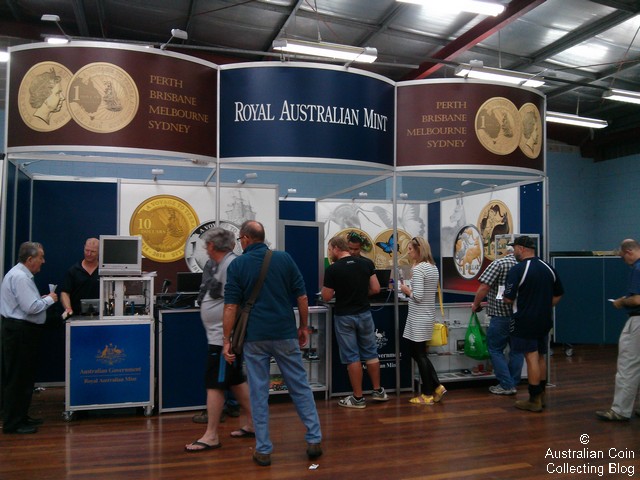
The Royal Australian Mint Stand
The Royal Australian Mint was in attendance this year and the RAM brought their portable press along, where for $10 you could press the button and counterstamp your own Voyage to Terra Australis dollar. According to the press operator the coin is supposed to have a mintage of 7,500 and no doubt will be distributed through the RAM dealer network. Never fear, if you didn't attend the show it won't be too hard for you to buy one of these coins. As well as the portable press the RAMfolk also brought along their usual array of NCLT and I am somewhat shamefaced to admit that I bought some of it. Including the new high relief 1 ounce mob of roos silver dollar and the pad-printed copper nickel mob of roos dollar. They are both pretty coins and interesting variations on the iconic circulation coin design minted for the 30th birthday of the Australian 1 dollar coin.
According to the ANDA Showguide I brought home with me there were another 41 dealers in attendance at the show and I can believe it. All tables had a dealer standing behind them and all of the tables were full of stock. If you came along to the show and didn't find something to buy then you either were not looking hard enough, are extremely picky, or are completely broke. Apologies at first to the stamp dealers because I didn't look at any of their tables so I cannot comment on who was or wasn't there. Local Queensland coin dealers of note that I recall include VP Coins, Global Coins & Banknotes, Roxbury's Auction House, Gold Coast Coins and Stamps, International Auction Galleries, Colonial Coins and Medals, David Rider Numismatics, and Claude Andresco Coins. Dealers who had made the trip from interstate included Sterling & Currency, Pacific Rim Coins, Australian Coin Auctions (Downies), Prospect Coins, Universal Coin Company, and Canberra Numisco. Particular credit must go to Andrew Crellin (of Sterling and Currency) who, having travelled the farthest of all dealers in attendance (from Western Australia) still had an amazing range of material to look at. I bought a couple of things off of him and I appreciate the effort he took to bring some specific coins for me to look at.
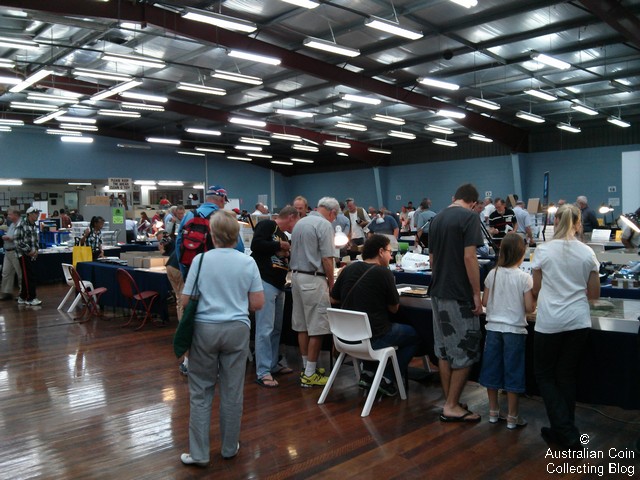
Big Crowds
Attendance before about 1.30PM was extremely strong and for the first time in a long time at an ANDA show I had to fight for a spot to sit and look. And amazingly it seems that people didn't just come to get their coins from the RAM, with most dealers reporting to me that their sales had been good. The types of coins being sold seemed to cover the full gamut, ranging from recent release NCLT, Australian decimal singles, modern world coins, quality Australian pre-decimal, and pricey errors and ancient coins. This doesn't surprise me though, as I believe it's a buyers market right now, especially for collectors of premium (and scarce) material. This idea was backed up after the show when I was talking to a very well known Australian numismatic identity. He suggested that now was the time to be snaffling up coin (and banknote) rarities with an eye to future long-term returns. For those (like me) who do not look to buy items from the top end of the market there were still bargains to be had for those on a lower budget. For example, the bottom has really dropped out of the Australian mint and proof set market and if you're looking to complete your run of sets now is the time to do it.
Given that we are strong supporters of third party graded coins (in particular those graded by PCGS) I should comment on their representation at the show. Chris Buesnell of Pacific Rim Coins had cases full of slabbed coins as did Sterling and Currency and Universal Coin Company. IAG and Monetarium Adelaide had some rarities in PCGS and NGC slabs and I noticed a few dealers with graded bullion coins (such as Kookaburras, silver kangaroos, and American silver eagles). Graded coins seemed to be primarily the domain of the "bigger" dealers though with very few of the local Queensland dealers having any at all. One comment I have to make though is that this is the first show in a long time where the discussion I had with show attendees regarding third party graded coins was entirely positive. Perhaps the collector market is starting to see the advantage of getting their coins graded and certified by companies such as PCGS and NGC.
That's another ANDA show report done and dusted. Thanks to everyone in Brisbane who I met and talked with. Thanks to the members of the Australian Coin Forum who I met at the show and in particular to the forum member in the Pac-Man hat that made him easy to find. And thanks of course to my fellow blog author who stayed home in Adelaide and manned (personned?) the battle stations while I was in Queensland looking at coins. Both of us will be attending the next ANDA show in Melbourne in early August so stay tuned for another riveting show report coming your way soon!
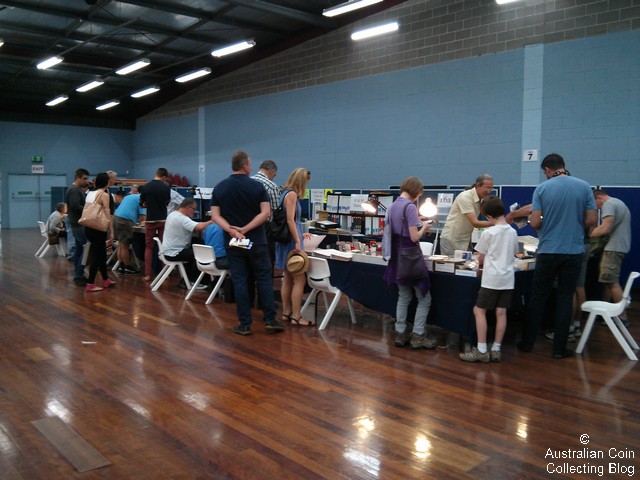
More Crowds
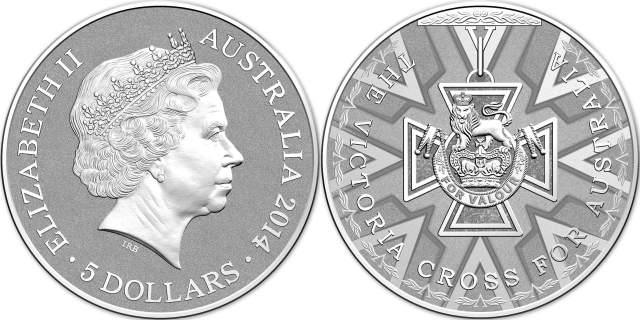
Silver Victoria Cross 5 Dollar Coin (image courtesy www.ramint.gov.au)
If you've ever watched ANZAC Day parades, commemorating the Gallipoli landing of 1915, you would have seen squadrons, platoons, companies, regiments, marching bands - a whole range of armed forces - proudly marching and displaying their medals. Even more noticeable, as war veteran numbers dwindle, are the family members who are also proudly displaying their relatives' medals.
Did you know that there's a protocol for the correct wearing of medals? Medals displayed on the left breast indicate the true owner and actual recipient of the medal, with the ownership of those medals remaining with that person, even in death. When medals get passed down to the next generation, those medals can only be worn on the right breast.
The highest military honour introduced by Queen Victoria on 29th January 1856 for "valour in the face of the enemy" during the Crimean War, is the Imperial Victory Cross medal (Imperial VC). And it ranks higher than all other orders, decorations and medals. Even the most senior military officer must salute a VC recipient, no matter what rank, as a mark of respect.
In 2000, the Royal Australian Mint released a memorial coin to mark the 100th Anniversary of the first Imperial Victoria Cross awarded to an Australian. The medal was awarded on 24th July 1900 to Major General Sir Neville Reginald Howse VC KCB KCMG for the rescue during the Boer War of a wounded man, despite being under attack himself.
To date, the Imperial VC has been awarded 1,357 times - with only 14 being awarded since the Second World War - 10 within the British Army and 4 within the Australian Army. However, since 1856 to current day, 100 Australians have been awarded the Victory Cross, and to mark this historic occasion, The Royal Australian Mint recently released (via ballot) a $10 antique copper coin (limited to 5,000). The coin is part of their Anzac Centenary Coin program, with the VC recipients names displayed in micro text.
The Victory Cross for Australia was introduced in 1991, replacing the Imperial VC awarded to Australians and is now the highest Australian military award. The wording for this award is "other persons determined by the Minister [for Defence] for the purposes of this regulation" - in essence not restricted to members of the Australian Defence Force but possibly open to police personnel and even civilians.
The Victory Cross for Australia has been awarded four times:
??? In 2009, to Trooper Mark Donaldson of the Special Air Service Regiment, who rescued an interpreter under heavy enemy attack in Oruzgan province, Afghanistan on 2nd September 2008.
??? In 2011, to Corporal Ben Roberts-Smith MG of the Special Air Service Regiment, after destroying two Taliban machine gun placements, during the 5-day Shah Wali Kot Offensive in Kandahar province, Afghanistan on 11th June 2010.
??? In 2012, to Daniel Keighran of the 6th Battalion, Royal Australian Regiment for drawing enemy fire away from an injured colleague and those tending to his injuries, in the Battle of Derapet in Oruzgan province, Afghanistan in August 2010.
??? In 2014, posthumously to Corporal Cameron Baird MG of the 2nd Commando Regiment, who was killed in Afghanistan in 2013 and previously awarded the Medal for Gallantry in 2007, for his part in a Taliban stronghold search and clearance operation.
Also part of the Anzac Centenary Coin program, the Royal Australian Mint has now released a five dollar 1 ounce fine silver frosted uncirculated coin to commemorate the 100th Australian receiving the VC (combined total of both the Imperial VC and the Victoria Cross for Australia). The reverse coin design depicts the Maltese Cross, with a lion guardant above a crown symbolizing the British Royal Family. The obverse depicts the portrait of Queen Elizabeth II, designed by Ian Rank-Broadley. The coin is issued at $70 with a capped mintage of 30,000 coins.
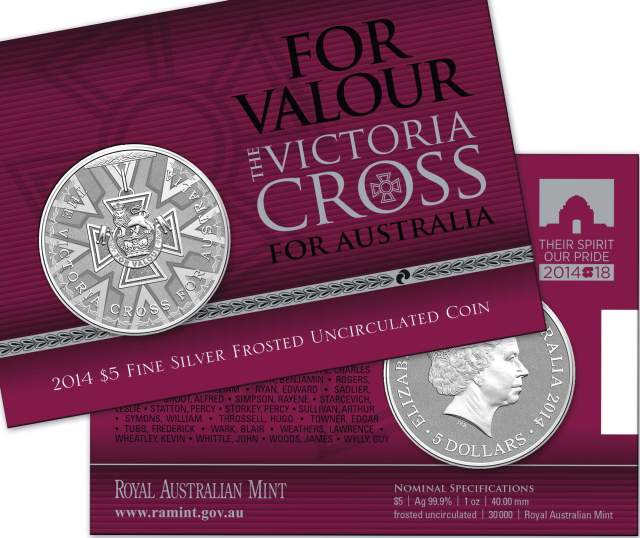
1oz Silver Victoria Cross $5 Coin in Pack (image courtesy www.ramint.gov.au)
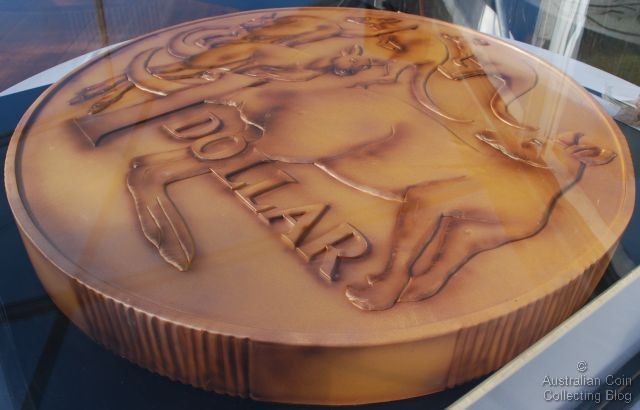
Let there be cake! The Mob of Roos One Dollar Cake at the Mint for the 2011 Product Launch
It's the 30th birthday of the iconic Stuart Devlin design 5 kangaroo dollar coin affectionately known as the "Mob of Roos". Open your wallet and you'll immediately pick out the attractive and timeless design coined by the master silversmith and designer of the echidna 5c, lyrebird 10c, platypus 20c and Coat of Arms 50c.
The Australian dollar coin was brought to life on May 14th 1984 when a coin replaced the dollar note. Our first "gold coin" to spend is actually struck in aluminium bronze with a gold appearance. The dollar proved extremely popular and has been struck with many many (many many) commemorative designs over the years, a browse through change will show you a sample of just how many there are from celebrating The International Year of Peace (the first commemorative in 1986), memorable Australians Sir Henry Parkes, Sir Charles Kingsford Smith, The centenary of Scouts, Girl Guides and APEC and CHOGM. The Royal Australian Mint has also struck many dollar coins that haven't entered circulation, coins specifically struck for collectors. Examples of these include a myriad of War related issues, various coloured birds and animals, the 75th anniversary of the Sydney Harbour Bridge, Blinky Bill, the Magic Pudding and the Steve Irwin dollar.
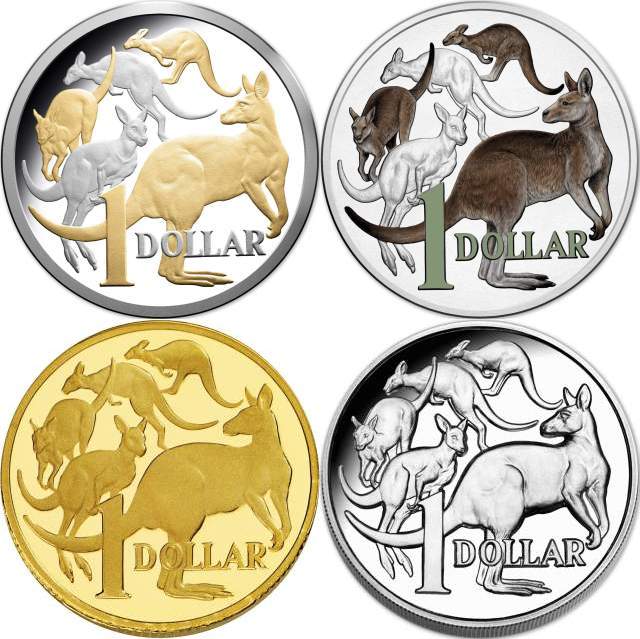
Proof Set Dollar (top left), Mint Set Dollar (top right), Wedding Set Dollar (bottom left) and High Relief 32mm Silver Proof (bottom right).(image courtesy www.ramint.gov.au)
The most popular is those 5 kangaroos and for the 30th birthday in 2014 the Mint has released some very special coins in commemoration. The normal standard 25 millimetre mob of roos struck on an aluminium bronze planchet can be found "tarted up" for this event. A coloured mob is found struck on an aluminium bronze planchet in the Mint Set. The proof set features a copper nickel planchet with gold plated kangaroos. The standard coin is also being counterstamped at various pop-up Mint shops in some capital cities. A larger (32mm) high relief silver mob can be found specially boxed. For more information on the various issues please see 2014 Australian Dollar Coins Issues and Mintages, as a dollar collector myself the plethora of issues even confuses me!
It was first reported in 1982 that government was to be going ahead with replacing the $1 note with a coin. It just made sense to replace a paper banknote with a lifespan of just 8 months with a coin you can still find in your change today 30 years later (yes, go and take a look!). The blanks among the first sourced from South Korea when the local supplier couldn't provide the quality of aluminium bronze alloy needed. This added to disruption at the Mint with industrial action prevalent around this time.
D Day or Dollar Day was 14th May 1984 and banks were instructed to return ALL dollar notes (even new one's) as soiled to the Reserve Bank to decrease the dual currency period. Before this date the dollar coin was not legal tender but some dollars sneaked out and were found in Brisbane and Sydney in early April 1984.
The distribution of coins by the Royal Australian Mint was the largest since the changeover to decimal currency in 1966. Convoys of semi-trailers travelled to various locations of the Reserve Bank with each semi carrying $10 million. These were escorted by plain clothed armed Commonwealth Police and was completed by March 1984 ready for D-Day. With all the fuss of the $1 coin, the birthday of the first $100 note on March 26th was completely overlooked!
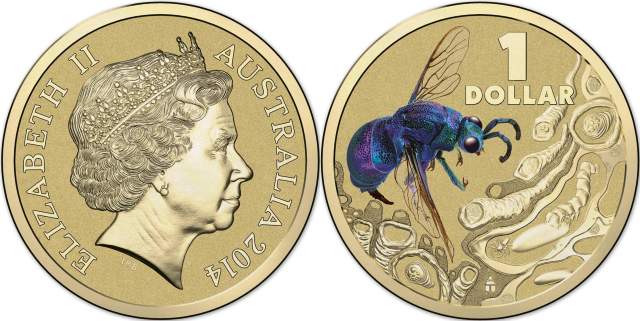
Pad Printed Colour Cuckoo Wasp Australian Dollar Coin in the Bright Bugs Series (image courtesy www.ramint.gov.au)
We all know about the Cuckoo Bird, don't we? They don't build their own nests, they lay their eggs in other bird's nests, and once hatched, the baby Cuckoo Bird pushes the "host" eggs out of the nest and takes over the nest for itself.
What if I told you that there's an insect that behaves just like the Cuckoo Bird? And would you be surprised to learn that it's name is the Cuckoo Wasp?
The Cuckoo Wasp belongs to the Chrysididae family and there are 76 different species within Australia. They are also commonly called the Emerald Wasp due to their iridescent green, blue or purple colouring. Their habitat is in the urban areas, forests and woodlands of Australia, most commonly found in Queensland and they feed on nectar. The Cuckoo Wasp is one of the six coins in the recently released Royal Australian Mints "Bright Bugs" series of one dollar coins.
This wasp lays it's eggs in the nests of other insects, most notably those wasps that build mud-nests in and around human habitation. For that reason, you've probably seen this brightly coloured wasp in and around your own home.
Once entrenched in a "host" nest, most Cuckoo Wasp's eggs will hatch first, with the larvae then feeding on the stored food left in the nest for the "host" larvae. However, the most likely scenario is that the Cuckoo Wasp larvae will actually feed off the "host" eggs or larvae. There are some Cuckoo Wasp eggs though that won't hatch until the "host" eggs have hatched and had their first meal. Then the Cuckoo Wasp eggs hatch, attacking and devouring the "host" larvae. Quite an ingenious but deadly method to ensure their survival.
As the "host" nest is invariably another wasp's nest, the female Cuckoo Wasp needs to defend itself if it's discovered when invading another wasp's nest. To avoid being stung, the Cuckoo Wasp rolls itself up into a tight ball so that it's external "armour" plates protect it from the other wasp's stings and biting mandibles. And as it's thought that the female Cuckoo Wasp doesn't sting, rolling into a ball is an effective defence mechanism. The long appendage that protrudes from a female's abdomen is in fact an ovipositor, used to insert and place it's eggs into the "host" nest.
The Cuckoo Wasp coloured $1 is pad printed with a frosted uncirculated finish and is one of the six coins minted by the Royal Australian Mint in the "Bright Bugs" series - a collection of 6 coins portraying "the prettiest bugs from around the country" with the catchy phrase "there's more to this bug than meets the eye".
The reverse of the coin depicts the Cuckoo Wasp's "life cycle" designed by Aaron Baggio - from a cross section of a "host" mud nest with a larvae attacking the "host" egg, through to the brilliantly iridescent adult Cuckoo Wasp itself. The obverse depicts the portrait of Queen Elizabeth II designed by Ian Rank-Broadley. This 25 millimetre aluminium bronze 9 gram 1 dollar coin is issued at $15.00 with a maximum mintage of 30,000 coins released.
Other coins in the 2014 Bright Bugs series released so far are the Ulysses Butterfly, Blow Fly and Stag Beetle. For up to date mintage information on this issue and other one dollar coins released in 2014 (the 30th birthday of the Australian Dollar Coin) see the 2014 Australian Dollar Coin Issues and Mintages table.
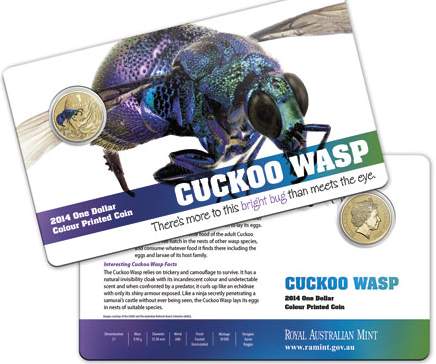
Cuckoo Wasp Australian Dollar Coin Packaging (image courtesy www.ramint.gov.au)
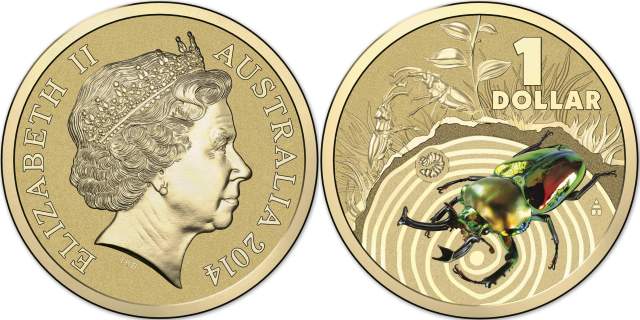
Pad Printed Coloured Stag Beetle Australian Dollar Coin in the Bright Bugs Series (image courtesy www.ramint.gov.au)
Did you know that there are more than 800,000 species of insects world wide? And that one fifth of all those insects are beetles?
Then consider this - in Australia there's estimated to be around 23,000 species of beetles, broken down into 121 families. With just one family, the Lucanidae family, containing 85 species of just one type of beetle?
Let's introduce you to this magnificent beetle, the Coloured Stag Beetle - also referred to the Rainbow or Mueller's Stag Beetle - depicted on the reverse of the recent release 1 dollar coin by the Royal Australian Mint, in the "Bright Bugs" series. The Bright Bugs series consists of 6 coloured Australian one dollar coins including the Blow Fly, Ulysses Butterfly and Cuckoo Wasp released so far. These dollars are struck in aluminium bronze, weigh 9 grams and are 25 millimetres in diameter.
This beetle is called a Stag Beetle because of their very large unusual mandibles, which are often just as long as their body. These mandibles resemble stag antlers and just as stags use their antlers to fight over the right to mate, the male beetles use their mandibles to fight over mating sites; as well as for fighting over food, which is typically tree sap and decaying fruits. Despite looking ferocious and frightening, Stag Beetles are not a threat to humans, but will draw blood if they pinch you.
Mating rituals begin when males are attracted to the female beetle's scent. If many males congregate around the female, fierce fighting ensues, with the victor winning the right to mate. Eggs are laid in rotten wood, which in turn provides food for when the eggs hatch. Beetle young are called larvae (or commonly called grubs) and develop through three to five larval stages, called instars, where they moult during each stage. The final stage of larvae development is a pupal state, from where they emerge as adult beetles. This whole process can take several years.
Coloured Stag Beetles are found in the tropical rain forests of Northern Queensland. They are nocturnal and are attracted to lights - however, despite their brilliant colouration, it's extremely hard to come across them in the wild. While they are eagerly hunted by collectors, it is now an offence to remove these beetles from any Australian National Park or Crown Land.
You can however keep them as pets or more easily just pickup one of these $1 colour printed frosted uncirculated Stag Beetle coins. It's one of six coins minted by the Royal Australian Mint in the "Bright Bugs" series - a collection of six 1 dollar coins portraying "the prettiest bugs from around the country" with the catchy phrase "there's more to this bug than meets the eye".
The reverse coin design depicts the Coloured Stag Beetle's "life cycle" designed by Aaron Baggio - from the males fighting over mating rituals, through to a cross section of a log contain a larvae, through to the transformation into the spectacular green Coloured Stag Beetle. The obverse depicts the portrait of Queen Elizabeth II designed by Ian Rank-Broadley. The coin is issued for $15.00 with capped maximum mintage of 30,000 coins. For up to date mintage information on this issue and other one dollar coins released in 2014 (the 30th birthday of the Australian Dollar Coin) see the 2014 Australian Dollar Coin Issues and Mintages table.
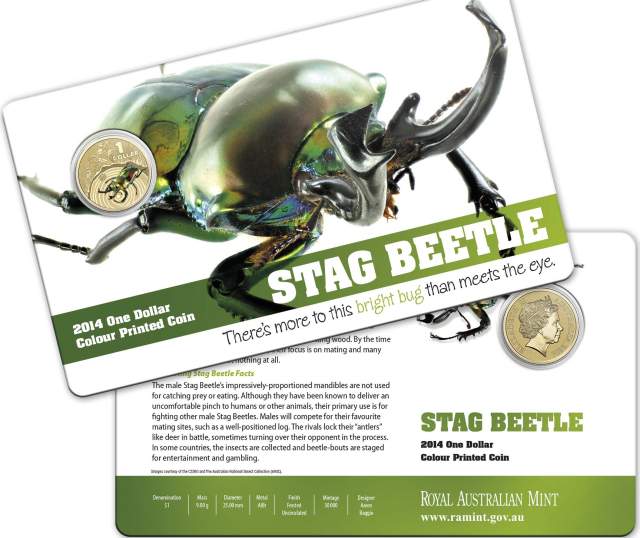
Rainbow Stag Beetle Australian Dollar Coin Packaging (image courtesy www.ramint.gov.au)
2014 Victoria Cross Ballot Coin (image courtesy www.ramint.gov.au)
The Royal Australian Mint is releasing a new $10 coin commemorating our nations bravest, the recipients of the Victoria Cross Medal as part of their Anzac Centenary Coin Program. This particular ten dollar coin is limited to just 5,000 minted so to secure one of these coins you'll have to enter a ballot draw. From now until 5pm aest on May 30th those interested in securing one of these coins will have to enter the draw via a link on the RAM website, calling the RAM contact centre or sending in a Legends member form. Upon validation of your entry and if successful in the ballot you'll be notified and asked to make payment.
The antique copper coin measures 57 millimeters and is issued in a presentation box for $100. All ballot winners will be required to pay the $12 shipping fee as there is no pickup available from the RAM giftshop.
The first coin* in the Mint's Anzac Centenary Coin Program sold out within days, the $5 triangular Lest We Forget silver proof coin and that coin had double the mintage. This VC coin will surely be very very popular.
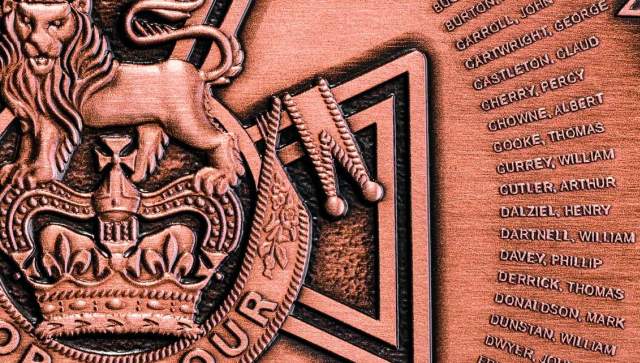
Victoria Cross Recipients on the Coins Reverse (image courtesy www.ramint.gov.au)
The names of the 100 Victoria Cross medal recipients adorn the reverse of this coin in micro-text around a depiction of the VC Medal with the words " FOR VALOUR" . A superb design commemorating our nations bravest who received the highest military honour.
Australia's 4 living Victoria Cross recipients were on hand at the Mint in Canberra yesterday to oversee the striking of these coins with Corporal Mark Donaldson VC's 7 year old daughter Kaylee pressing the button to mint a coin for her Dad.
The ANZAC Day University of Canberra Brumbies Rugby Match also put aside the coin toss at the start of the game, and as a mark of respect and commemoration instead playing a quick game of two-up with the specially struck coins.
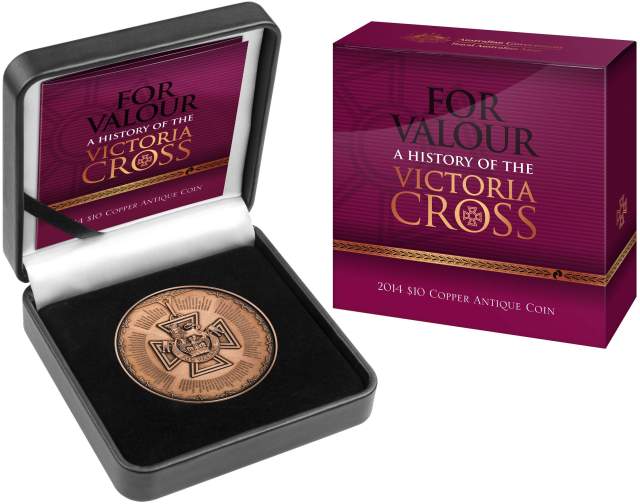
2014 VC $10 Copper Antique Coin (image courtesy www.ramint.gov.au)
*The first coin announced was the circulation ANZAC centenary dollar with 23 million released for circulation. It appears the Royal Australian Mint can't decide if that coin was in fact part of the program having announced conflicting information to date.
Last month, Singapore played host to one of the hobby's premier events: The Singapore International Coin Show. Sydney gold sovereign dealer Eric Eigner from Drake Sterling Numismatics flew up for the week to attend, and during the long flight home took the opportunity to write up a report about his trip. We've reproduced it below.
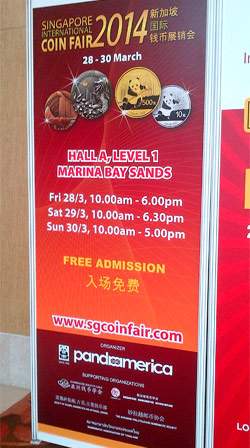
Singapore International Coin Fair 2014
It's been a while since I've travelled abroad for a coin show. However, with the cancellation of the Petersham Coin Show this March (the show will be back on once renovations to the venue are completed), I took the opportunity to attend a coin show a little farther afield.
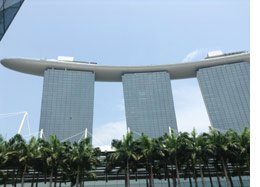
Marina Bay Sands
The Singapore International Coin Fair is held every year at the end of March in one of Singapore's premier hotels, Marina Bay Sands. As one of the biggest coin shows in the Asia-Pacific region, the show attracted a large and diverse range of international and local dealers, as well as many of the world's official mints, accessories suppliers, and the two largest coin grading services, PCGS and NGC.
When I arrived Friday morning, the registration area was crowded and the queues long. It took me almost half an hour to get my collectable visitors booklet and badge. But it was worth the wait. The registration area was in a long hallway, but the show itself was inside the high-roofed, warehouse style hall nearby. The first tables before me had crowds before them three or four people deep. The coins of interest were mainly Chinese, Malaysian, and some bullion.
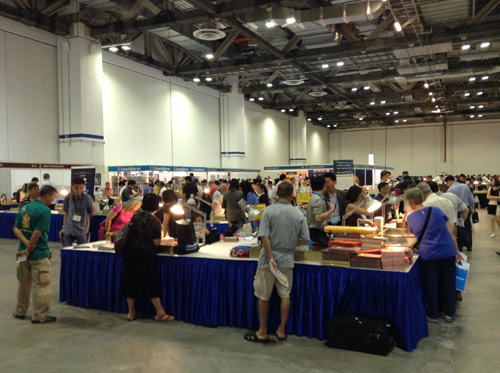
Inside the Coin Fair
Walking about the room, I noticed a clear Asian focus in terms of the kind of coins that were on offer. This is not surprising. I did not quite expect to find hoards of Australian rarities, but I was hoping to find the odd Aussie coin or two that might pay for the trip. Sadly, Australian coins, even gold sovereigns, which are international coins, were thin on the ground.
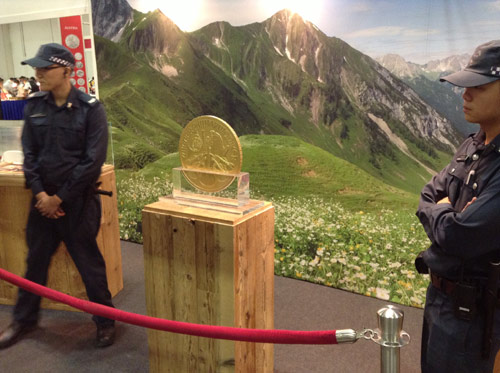
31.103 kilos of Gold, face value of ???100,000 Euros
In addition to the traders, there were also exhibits and presentations. On special display was an Austrian Philharmonic gold coin. Containing exactly 1,000 ounces of gold and worth over AU$1.4 million at current prices, the coin was the centrepiece of the Austrian Mint's trade display. Guards, armed with somewhat underwhelmingly small pistols, stood left and right of the display. An extra guard circled the stand from a distance, no doubt keeping an eye for suspicious activity.
US Uncut Banknote Sheets
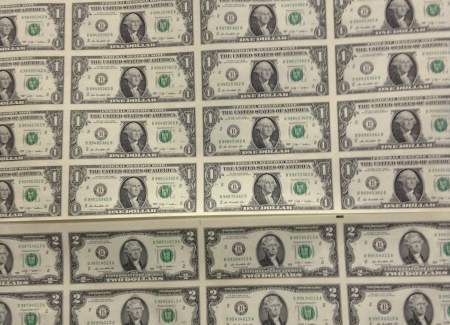
Meanwhile, a banknote dealer had wallpapered the back board of their display with uncut sheets of United States one and two dollar bills. I could not resist the temptation to purchase a sheet myself, and am now the proud owner of an uncut sheet of thirty-two one dollar bills. Near the area where presentations were held, there was a display of original currency vignettes from various small countries. There was also a display of original printing plates from which the vignettes were produced. Perhaps most interesting was a small display of intricately designed company bonds. The most famous company of all was the Coca-Cola Bottling Company of Los Angeles. There was also a specimen bond, accompanied by a printing plate, from the Pepsi-Cola Company.
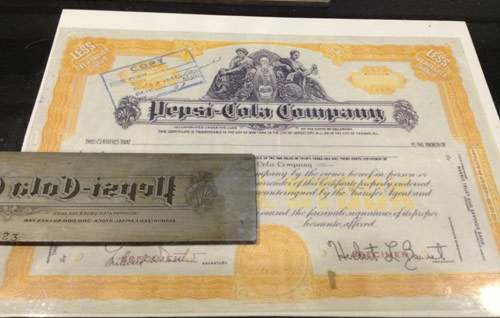
Pepsi-Cola Bond and Printing Plate
Afterwards, I made a quick visit to the PCGS stand, where the Vice President of International Development Muriel Eymery was engaged in deep conversation with a collector. She had on hand one of PCGS' new sample holders and was demonstrating the use of the holder's new 3D security hologram.
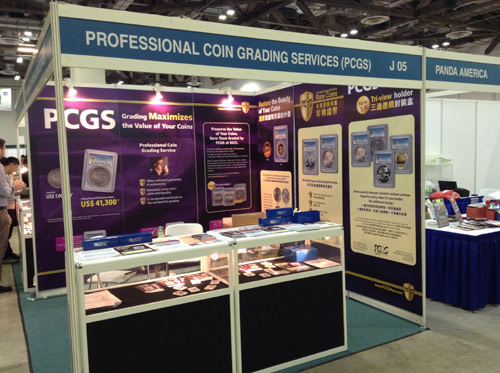
PCGS Stand
Overall, it was a good show. Business appeared to be brisk, sales were strong, and the range of coins and currency available for sale was broad, albeit Asian-centric. Unfortunately, because the Petersham and Singapore Coin Shows are held on the same weekend each year, I will be unable to attend next year's Singapore show; however, given the option, I'd certainly attend again and recommend collectors in the area make the short flight to drop by.
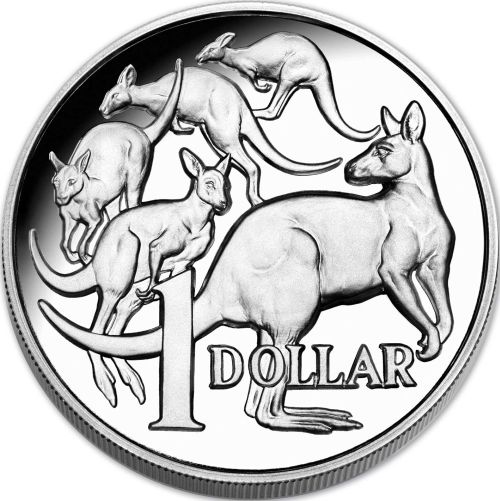
2014 Mob of Roos Dollar in High Relief Silver (image courtesy of the Royal Australian Mint)
The Royal Australian Mint has just released the iconic mob of roos one dollar coin in one ounce silver form. The coin is released to help celebrate the 30th anniversary of the appearance of the Australian dollar coin back in 1984.
While this isn't the first oversized mob of roos dollar we've seen in silver (there was one in the 2004 Masterpieces in Silver set) it is the first time we've seen it as a full one ounce and with a diameter of 32mm. Those of you who know a little about 1 ounce silver coins probably have pricked ears right now because 1 ounce silver coins are usually crown sized, 38mm or more in diameter. Well, the 32 millimeter diameter gives away that the coin is to be struck in high relief on a thick planchet. As far as we are aware this is the first time the RAM has released a product officially classified as high relief (though the Perth Mint has been doing it for a while now). It will certainly be interesting to see this familiar design struck in high relief.
The coin is to be struck in 99.9% silver with a mintage of 10,000 coins and based on images on the RAM website appears to ship in one of their black coin boxes with an information card. The obverse bears the usual Queen Elizabeth II portrait by Ian Rank-Broadley while the reverse shows the 5 kangaroos as first sculpted by Stuart Devlin for the dollar coin in 1984.